
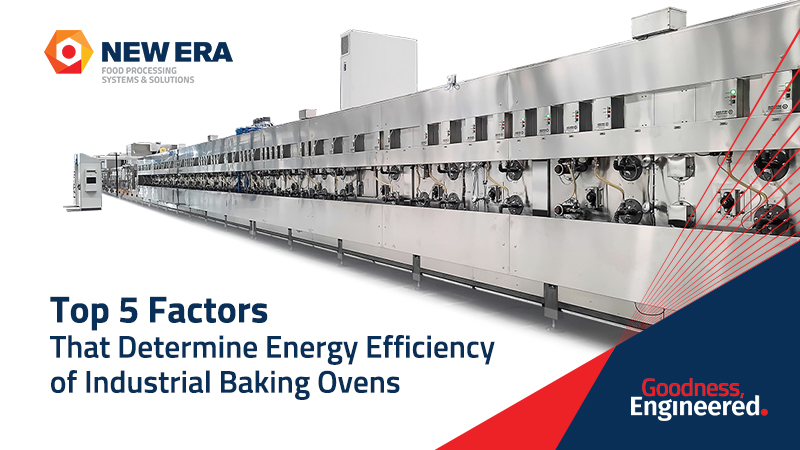
Energy efficiency is not a luxury need anymore; it is a game-changer when it comes to the operational benefits of manufacturers. In the case of large-scale bakeries, the Industrial Baking Ovens are considered as some of the most energy-intensive production floor assets. These ovens are designed, integrated, and operated in such a manner that it directly influences the fuel usage, throughput, product consistency, and long-term profitability in the long term.
As the cost of energy increases and the demand for sustainability goes up, manufacturers are reassessing their baking equipment that not only focuses on capacity, but also efficiency. Energy-saving ovens minimize the operating cost, decrease carbon footprints, and offer more control over the final results in baking. But efficiency is not a one-sided factor of determination, but a product of numerous factors operating in relation to each other.
This blog will discuss the five key factors that are used to define the energy efficiency of Industrial Baking Ovens.
#1 Heat Retention and Insulation Efficiency
The ability of heat to be trapped within the baking cavity is one of the most basic elements determining the energy efficiency of the Industrial Baking Ovens. The amount of heat that is lost through oven walls, doors, or joints is directly proportional to the increased fuel usage or electricity consumption.
The importance of insulation quality: Performance insulation materials, including mineral wool or ceramic fiber, reduce heat dissipation and ensure stable interior temperatures.
Efficient insulation guarantees:
- Faster heat-up times
- Less load on the burner or heater
- Reliable baking results over extended production cycles
Also, ovens are frequently used on a continuous basis during biscuit and cookie production lines. Insulated tunnel ovens assist in maintaining uniform thermal profiles, which avoids repetitive reheating processes that consume power.
Now, what should you focus on for better efficiency? Using ovens and baking systems from renowned baking equipment manufacturers can help improve efficiency. The engineered technology and design of their systems enable the heat to be spread well in the baking area, with cooler outer surfaces, which enhances energy saving and improves operator safety.
#2 Efficient Airflow and Even Heat Distribution
Energy efficiency is not just a matter of the amount of heat produced; it is also a matter of how even and smart the distribution of the heat is. Inadequate air circulation causes hotspots, imbalanced baking, and overcompensation through added energy.
“Optimized airflow = optimized energy use”
Modern airflow allows the circulation of heated air throughout the full width and length of the product.
This allows ovens to:
- Bake at reduced average temperatures
- Minimize rework due to unevencoloring
- Ensure consistent product quality
- The balanced airflow uses less energy to produce the same baking outcome
In continuous cracker or cookie baking lines, convection technology is typically used to move warm air to where it is required. The dampers and zoned airflow controls can be adjusted to ensure consistency even when the product changes in terms of thickness and moisture content.
#3 Smart Temperature Control and Automation
An Industrial Baking Oven is highly energy efficient and cannot run at the same temperature at all times. Instead, it utilizes several autonomously managed heating areas, each of which is optimized to a particular phase of cooking.
The reason why zonal control is efficient: Different baking processes, such as dough setting, moisture removal, and surface coloring, require different temperatures.
Zonal control allows:
- Reduced energy input when baking early or late
- Controlled use of heat where it is needed
- Lower total fuel consumption
Automation systems also increase efficiency by modulating temperatures, conveyor speed, and airflow. Tunnel ovens in automated biscuit and cookie lines are most commonly separated into several areas with separate burners or heaters. These areas are coordinated with the upstream and downstream equipment, which means that the oven uses the power only in accordance with the real production needs.
#4 Fuel Efficiency and Heat Recovery Systems
Fuel and burner technology can be very important in deciding the efficiency of the oven. Regardless of the source of energy, be it gas, diesel, or electricity, efficiency is determined by how well energy is translated into useful heat.
Key considerations:
- Maximum combustion output is achieved through high-efficiency burners
- Accurate control of flame eliminates waste of fuel
- Constant fuel-air ratios minimize the heat loss
Also, exhaust heat can be reclaimed with heat recovery systems that reuse the heat to preheat air or other process stages.
#5 Integration with the Overall Baking Production Line
An oven does not work well in isolation. Its energy consumption also depends a lot on its ability to interact with the other baking production line such as mixing, forming, and cooling.
Why integration matters: Lack of synchronization contributes to idle running, unnecessarily repeated reheating, and irregular product flow.
Efficient integration will guarantee:
- No periods of stagnation of products
- Ideal conveyor speeds that aligned with baking profiles
- Less energy wastage when in downtime
An oven that is very well integrated will be integrated as a part of a very smooth and efficient energy environment.
Energy Efficiency as a Strategic Advantage
Innovative Industrial Baking Ovens are not merely a technical specification, but also a strategic investment with quantifiable business effect. Around 62.1 percent of food manufacturing companies had achieved quantifiable improvements in energy efficiency after using operational enhancement measures and new process technologies like enhanced insulation, automated controls, and heat recovery technologies.
Efficient ovens and production lines provide benefits like:
- Reduce long-term operational costs through lower fuel and electricity usage.
- Better environmental impact credentials, aligned with global sustainability goals.
- Increased product uniformity and throughput due to optimized bakery conditions and lower variability.
Working with reputed Baking Equipment Manufacturers like New Era, the bakeries can implement energy efficiency as a design principle, not just as an additional feature. Whether it is insulation and airflow or automation and line integration, each design decision will lead to quantifiable energy savings and competitiveness.
Conclusion
Intelligent engineering, as well as process-oriented design have led to the development of Energy-efficient Industrial Baking Ovens. Through insulation quality, zonal temperature, and a lot more factors, bakeries will be able to save a lot of energy without affecting production or quality.
Being a reputed brand in the field of Baking Equipment involved in the production of baking equipment, New Era Machines ensures that the design of production-line packages aims to incorporate the element of energy-saving into all the stages of baking. At New Era, we not only focus on the baking stage but also the ultimate product delivery stage, as a means of enabling manufacturers to sustain growth in a way that is cost-effective and sustainable.
In search of a baking oven that is productive yet energy efficient? New Era’s Baking Equipment is what you need Contact now!
FAQs
1. What is the reason why Industrial Baking Ovens are energy-consuming?
They work under high temperatures, over extended periods, and therefore, insulation, airflow, and fuel efficiency are important in regulating energy consumption.
2. What is the impact of airflow on the energy efficiency of ovens?
Even baking, even at lower temperatures, is ensured by uniform airflow, which avoids the use of excess heat and conserves energy.
3. Are automated ovens energy-saving?
Yes. Automation also optimizes temperature, air flow, and conveyor speed in real-time so that unwarranted energy consumption is avoided.
4. Is energy efficiency to be a factor in selecting Baking Equipment Manufacturers?
Absolutely. Established manufacturers like New Era create ovens and production lines in which the system is designed to be energy efficient, rather than added in afterwards.