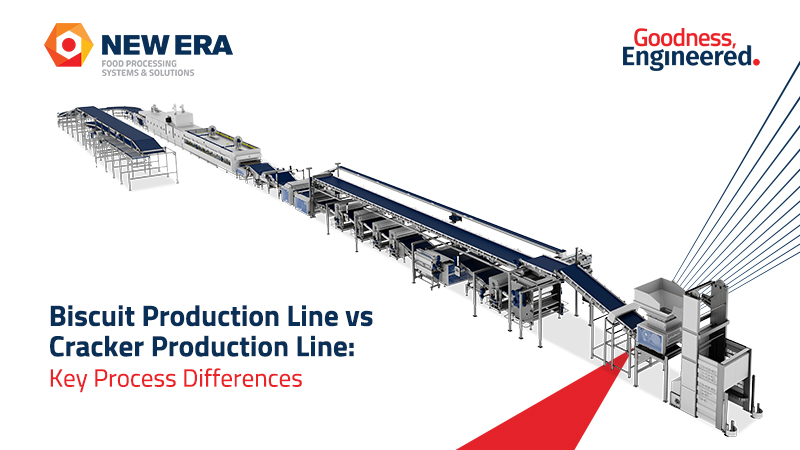
If you enter any supermarket, you will see different varieties of biscuits and crackers lining the shelves. At first, these products look identical, but they are quite different due to their manufacturing methods. Every product offers a different experience for the consumer, ranging from the buttery biscuit to crisp crackers, and all of these experiences rely on carefully structured production lines.
When a bakery manufacturer is considering investing in automation or expansion, it is crucial to understand the difference between a biscuit production line vs cracker production line. The equipment setup, dough production, baking conditions, and flow are very different from each other.
Let’s explore the key process differences between biscuit and cracker manufacturing lines and understand why each process requires a different approach
Understanding the Key Differences Between Biscuit and Cracker Production Lines
1. Dough Preparation
The first step in making a good product is to prepare a good dough. The major differences between biscuits and crackers start in the mixing stage.
Generally, biscuit dough is sweeter, softer, and richer because it is made from a high content of sugar, fat, milk solids, and flavourings, which give biscuit texture and sweetness.
Cracker dough, on the other hand, is typically leaner. It has less sugar and fat content, and emphasises flour, water, yeast, and salt.
A modern bakery that makes butter cookies, for instance, might need a dough mixing system with a large capacity and a means of distributing the fat evenly throughout the dough. On the other hand, a cracker manufacturer producing salted crackers could require a mixer that is equipped with special features for yeast manufacturing and longer fermentation times.
Consequently, biscuit and cracker lines have different mixing systems designed to handle the different characteristics of the biscuit and cracker dough.
2. Fermentation Requirements
The fermentation process is one of the most salient characteristics that differentiate the biscuit production line from the cracker production line.
Biscuit Production Lines
Most biscuits do not require long fermentation periods. Once mixed, the dough generally moves directly onto the forming and shaping operations.
Benefits include:
- Faster production cycles
- Reduced floor space requirements
- Simplified process control
- Increased throughput of sweet biscuit varieties
Cracker Production Lines
Crackers are often fermented or rested.
This stage:
- Develops characteristic flavours
- Improves dough extensibility
- Creates the desired texture and layering
- Improves the end product crispness
In a typical cracker manufacturing configuration, there are fermentation rooms or dough resting conveyors before sheeting.
This further processing step can have a big impact on the production line’s layout and complexity.
3. Dough Forming Technology
After making the dough, the next important part of making the product is shaping the dough to achieve the desired texture and appearance in the finished product. This is where the distinction between a biscuit production line vs cracker production line becomes even more apparent.
Biscuit manufacturing typically uses rotary moulders, wire-cut systems, biscuit depositors, or rotary cutters. The machines produce a variety of shapes, embossed patterns, and decorative finishes.
The production of crackers is quite different. The dough is not moulded but is progressively thinned by a series of sheetings and gauging operations. Many laminators are used to add layers to the dough that help give the cracker its crispness.
4. Product Texture Determines Equipment Design
Each production line is shaped to meet the needs of consumer texture expectations.
Biscuit Texture Requirements
- Moisture-rich, soft, and crumbly textures
- Crispy and crunchy finishes
- Rich, buttery mouthfeel
- Filled or sandwich-style structures
These textures can only be developed with careful dosages, mixing, and baking conditions.
Cracker Texture Requirements
Cracker production concentrates on providing:
- Uniform crispness
- Distinctive snap and breakability
- Consistent moisture levels
- Well-defined layered structures
To maintain these characteristics, manufacturers rely heavily on accurate sheeting, fermentation control, and carefully managed baking conditions.
5. Baking Process and Oven Configuration
The oven is where the real transformation happens. The baking conditions of biscuits and crackers are very different, which allows them to get that characteristic texture, colour, and taste.
The primary objective of biscuit production is to create a rich golden colour, good aroma, and an optimum crispness or softness. Many biscuit manufacturers use controlled tunnel ovens to create even baking, as biscuit dough is generally richer in sugar and fat content.
The baking of crackers is a different story, though, where lightness and crispness are essential, and the snap and crunch are the hallmark of the product. Care must be taken in the baking cycle to control heat and moisture in crackers because they are thin and are frequently laminated. Therefore, modern cracker lines employ specialised tunnel ovens that provide even heat distribution.
6. Post-Baking Processes and Product Handling
After the products come out of the oven, they enter a critical stage where product quality can either be preserved or compromised.
Typical Biscuit Line Operations:
Many biscuit manufacturers add value to their products in a number of ways, including:
- Cream filling
- Chocolate coating
- Sugar dusting
- Sandwiching
- Decorative topping application
Cooling conveyors, filling systems, and automated packaging lines can be integrated into the production line to enable continuous production, enhancing efficiency while supporting product diversification.
Typical Cracker Line Operations:
In general, cracker production consists of the following steps:
- Controlled cooling
- Oil spraying
- Seasoning application
- Automated packaging
As crackers are more fragile than some biscuit types, handling systems need to be designed to reduce cracking and preserve product appearance during the packaging process.
Why Production Line Selection Matters More Than Ever
The global biscuit and crackers industry continues to expand due to rising demand for premium bakery products. In fact, the biscuit, cookies, and crackers market in India will be worth around US$18.87 billion by 2030 with a CAGR of 6.8%. This growth is driving investment in the use of advanced bakery automation and high-capacity production equipment.
A trusted biscuit and cracker production line manufacturer, such as New Era, equips manufacturers with a stable system that operates reliably to ensure product quality.
Conclusion
The difference between a biscuit production line and a cracker production line shows that these manufacturing systems are based on different properties of the product being produced.
Biscuit lines are more concerned with flexibility, rich doughs, and variety of products, whereas cracker lines are more concerned with fermentation and lamination, and keeping the texture consistent.
Whether preparing cookies with top-of-the-line equipment or baking biscuits and crackers, selecting the right equipment from trusted crackers and biscuit production line manufacturers in India is essential for long-term success.
New Era’s extensive knowledge of bakery automation helps manufacturers transition to efficient, scalable and future-proof production solutions. Our production line helps you achieve your current objectives, customer base, and future goals.
| Choose the right production line tailored to your needs with New Era! |
FAQs
1. What is the main difference between biscuit and cracker production lines?
The main distinction lies in the dough preparation and fermentation. Typically, biscuit lines use richer doughs, with little fermentation, and cracker lines require fermentation and lamination.
2. Do crackers require special equipment compared to biscuits?
Yes. The process of making crackers usually demands the use of sheeters, laminators, fermentation systems, and particular baking setups to create the specific layered texture and crispness.
3. Is it possible to use one production line to make biscuits and crackers?
Depending on the situation, highly flexible systems can be used for several different products, but dedicated lines tend to produce more efficiency, consistency, and a better product.
4. Why are automated biscuit production lines becoming more popular?
Automation increases production speed, decreases dependence on labour, aids in product uniformity, reduces waste, and helps meet the production demands of large-scale manufacturing.