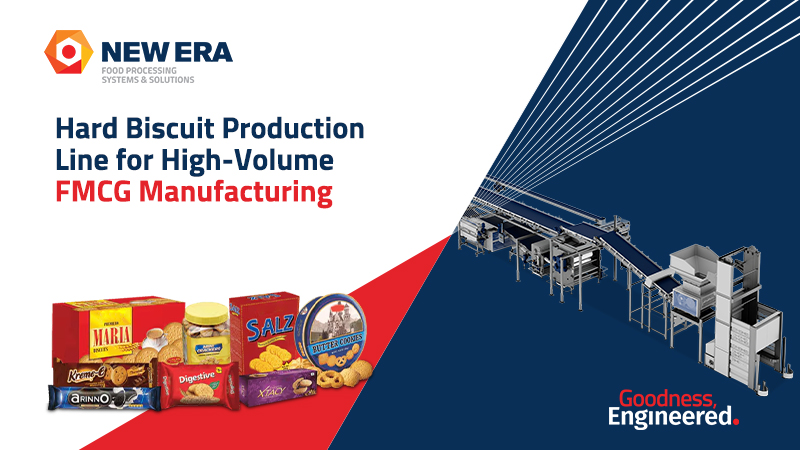
Producing biscuits at scale for the FMCG sector requires more than just a good recipe and conventional machines. If the dough’s thickness, moisture content, baking temperature, or biscuit weight differs even a little, FMCG manufacturers can lose a lot of product quality and increase production costs.
That is where a hard biscuit production line becomes strategically important. The mixing, forming, baking, cooling, and handling processes are integrated into a single, controlled manufacturing workflow.
In a market where FMCG brands are playing on price, availability, and consistency, the right production line can become a competitive asset.
Let’s find out more about the hard biscuit manufacturing line for FMCG.
7 Reasons Why a Hard Biscuit Production Line Matters in FMCG Manufacturing
1. Consistent Dough Preparation
The consistency starts way before the biscuit goes into the oven. The ingredients, mixing time, dough temperature, and moisture levels of hard biscuit dough need to be controlled.
Industrial horizontal mixing systems can process large batch sizes and still achieve uniformity from batch to batch. One example of this approach uses mixers designed for approximately 70–1,000 kg per batch and includes recipe management features.
For FMCG manufacturers, this is important because it can impact all subsequent steps, including sheeting and baking.
2. Precision Sheeting and Lamination
Compared to soft biscuits, which are moulded directly, hard biscuits are typically sheeted and, if necessary, laminated.
The dough is gradually rolled out to the desired thickness before being layered. The thickness, bite, appearance and baking behaviour of biscuits are governed by precise control here.
By designing the line to incorporate dough rolling, sheeting and laminating processes, the material can be processed continuously without manual handling.
This is especially important in the production of high-volume FMCG products where a small stoppage can lead to significant production losses.
3. High-Speed Rotary Cutting
The dough is then rolled out to the appropriate thickness, and then the biscuit pieces are cut out using rotary cutting. The cutting system should ensure that the dough is cut to the right size and minimise the amount of dough scrap. One of the most important advantages of automated scrap recovery is that unused dough can be returned to the production process rather than being discarded as waste.
A modern hard-dough system can integrate sheeting, cutting, and scrap recovery in a single process and lead to high throughput and less rework. This translates into consistent piece weight, shape, and production efficiency for brands that manufacture standardised products in volume.
4. Multi-Zone Tunnel Baking
The oven must be considered the backbone of the production line. The baking of hard biscuits is a delicate process requiring very careful control so that the biscuits are crisp, coloured and moisture-free. A multi-zone tunnel oven enables manufacturers to set different parts of the baking profile, as compared to the traditional single uniform temperature throughout the oven.
This is especially relevant if the manufacturers have several recipes or biscuit sizes. Energy efficiency is also important. At FMCG scale, even incremental improvements in thermal efficiency can influence operating costs significantly over thousands of production hours.
5. Controlled Cooling
Taking the biscuit out of the oven does not complete the production process. Freshly baked biscuits have to go through the controlled cooling process prior to stacking and packing. Cooling conveyors help in product stabilisation and prevent excessive heat from reaching packaging or condensation problems.
Therefore, it is important to take airflow, conveyor speed, and cooling time into account as part of the overall production design instead of an afterthought.
A well-integrated line, such as New Era’s, provides a seamless connection from the oven discharge to cooling and handling.
6. Automation and Hygiene
Repeatability is key to FMCG manufacturing. Manual and multi-step operations increase the chances of inconsistent handling, contamination, and production downtime. Automated feeding, detection and rejection, conveying and stacking systems reduce the need for human intervention and ensure a continuous product flow.
Hygienic equipment design is another important aspect. Factors such as food-contact parts, cleaning access, and minimising manual handling all contribute to safer and easier operations.
7. Scalability for Future Demand
One of the biggest blunders FMCG manufacturers can make is choosing machinery for existing production demands. Demand may fluctuate rapidly following a successful product introduction, a new distribution agreement, or a new market in the export domain. For this reason, a production line should offer a logical way to expand its capacity.
By using modular equipment, automated controls, and the right-sized baking and cooling equipment, manufacturers can expand their capacity based on future needs and not have to constantly replace key equipment.
This is where experienced hard biscuit production line manufacturers can add value: the objective should be to engineer a production ecosystem around the manufacturer’s product mix, capacity, factory layout, and growth strategy.
Soft vs Hard Biscuits: Why the Production Technology Differs
It is important to know the difference between soft biscuits and hard biscuits when selecting machinery.
Hard biscuits usually need a stiffer, more elastic dough, which can be pulled, layered, and rolled out into a dough sheet. This process is usually employed for making hard biscuits, crispy crackers, etc.
Soft biscuits, on the other hand, are usually manufactured from softer, higher-fat doughs, and can be formed by rotary moulding or other moulding processes. As a result, their dough-handling needs are different.
| Parameter | Hard Biscuits | Soft Biscuits |
| Dough characteristics | Firm and elastic | Softer, richer dough |
| Forming | Sheeting, laminating and rotary cutting | Often rotary moulding |
| Texture | Crisp and brittle | Tender or crumbly |
| Key control areas | Thickness, lamination, baking and moisture | Dough handling, moulding and baking |
| Typical products | Marie, crackers and similar crisp biscuits | Shortbread, butter-style and soft-textured biscuits |
It’s not just a categorisation of a product. It directly affects the configuration of the mixer, forming equipment, oven requirements, cooling systems, and the overall automation structure.
This can result in an incorrect production setup for an FMCG manufacturer if the word “biscuit” is the only consideration in choosing equipment.
What to Evaluate When Selecting a Biscuit Production Line for FMCG Manufacturing
When choosing a biscuit production line for FMCG biscuit manufacturing, there are a number of aspects to consider.
Manufacturers should examine:
- Assess the actual required output (kg/hour), not just the machine’s headline capacity.
- Ensure the line is optimised for the type, size, and recipe of the hard biscuit produced.
- Make sure that mixing, feeding, sheeting, laminating, cutting, baking, cooling, and stacking are all combined.
- Evaluate oven efficiency, since it can have a substantial impact on long-term operating costs.
- Minimise variations through recipe management, process monitoring, automatic rejection and production controls.
- Consider accessibility, as well as the availability of components and service support, since these affect uptime.
- Confirm whether the line can meet increased production capacity or new SKUs as the company expands.
A good equipment partner should also know how the equipment pieces work with each other. Increasing the cutter’s speed, for example, has little value if the oven or cooling section cannot accommodate the resulting throughput.
Why High-Volume Capacity Matters
The size of the biscuit opportunity in India justifies the need for efficient manufacturing infrastructure. By 2030, the Indian biscuits market is expected to generate revenue of USD 8,692.8 million.
For manufacturers, the message is clear: as a category gains market size and product variety, it necessitates production efficiency. For FMCG companies, the machine must be capable of maintaining consistent production volume without affecting the product specifications.
A well-designed hard biscuit line can help address that requirement by connecting process control, automation, and throughput within a single manufacturing architecture.
Conclusion
A high-volume biscuit business cannot rely on single machines or manual process adjustments. It demands a synchronised production procedure, which must be precise and repeatable. The right hard biscuit production line should therefore be chosen based on product requirements, target capacity, energy efficiency, and future scalability, and not just based on the production line’s claimed output.
If your biscuit manufacturing plant requires high-volume production, we are New Era, hard biscuit production line manufacturers. We combine engineering skills with production-line solutions tailored to the demands of industry.
| Build the best production line for manufacturing hard biscuits with New Era. |
FAQs
1. What is a hard biscuit production line?
In a Hard Biscuit Production Line, a continuous operation of mixing, sheeting, laminating, cutting, baking, cooling, and handling is combined into a single, interconnected process. This guarantees standard and quality production of biscuits at a large scale.
2. What biscuits can be made in a hard biscuit line?
Hard biscuit lines produce crispy biscuits, crackers, and other sheeted products, depending on the baking set-up and recipe.
3. What is the difference between a hard biscuit line and a soft biscuit line?
There are two types of biscuit lines: hard biscuit lines rely on processes of sheeting, lamination, and rotary cutting, and soft biscuit lines typically include rotary moulding of softer doughs.
4. What are some factors to take into account before purchasing a biscuit production line?
Determine capacity, product offering, automation, energy efficiency, hygiene, maintenance, scalability, and seamless integration across the entire production process.