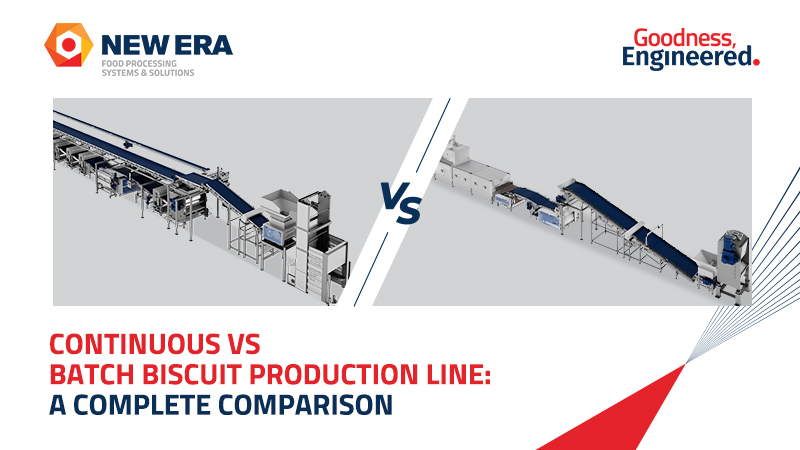
So, what happens when a biscuit manufacturer needs to shift from making more batches to delivering a smoother and more streamlined production process? The solution is not always as straightforward as swapping one machine.
Biscuit manufacturing involves a number of steps: mixing, feeding, forming, baking, and handling after baking. While dough itself may be prepared batch-by-batch, the subsequent production stages can be designed for continuous movement. This is why it’s crucial to know the difference between continuous vs batch biscuit production lines when considering capacity expansion or increased automation.
The appropriate configuration is determined by the type of biscuit, output desired, product consistency, and the level of automation desired in the plant. Let’s dive deep into the comparison.
Continuous vs Batch Biscuit Production Line: 7 Factors to Consider
1. What is the Production Process?
A batch biscuit production line starts by mixing the ingredients in fixed proportions. Each dough batch is prepared according to the recipe before being discharged for further processing.
For instance, in biscuit and cracker applications, the modern horizontal biscuit mixer can be used for batch sizes ranging from around 70 kg to 1,000 kg. Consistency between batches can be achieved through Z-arm mixing, controlled mixing time, and dough-temperature and recipe management using a touch panel.
Continuous processing becomes particularly relevant after mixing. Automated dough feeding systems can convey mixed dough from the dough mixer to the next processing equipment while keeping the dough flow under control.
2. Dough Feeding and Material Handling
The step of shifting from mixing to forming is very important. Manual handling can cause delays in production and cause variations in dough distribution.
Depending on the dough and application, automated feeding systems can be equipped with conveyors, hoppers, metal detection, and automatic rejection. Accurate distribution of dough and automatic feed control aid in smoothing the flow between each stage of the process.
This demonstrates how batch and continuous processing can complement each other rather than working as two distinct manufacturing methods.
3. Forming Requirements Depend on the Biscuit
The right production configuration also relies heavily on the product being manufactured.
Sheeting, laminating and rotary cutting are some of the processes that are required for manufacturing hard dough biscuits and crackers. These processes are carried out using sheeting lines, lamination lines and short-footprint sheeting systems, which can be fitted into production systems depending on plant layout and output needs.
The method of forming soft dough biscuits is different. Rotary moulding systems are used to form high-fat, low-moisture dough directly, and can provide control over the knife setting, pressure and gaps. Moulding rollers can also be customised for different biscuit designs and branding.
So, when considering continuous vs batch biscuit production line configurations, manufacturers should also take into account the nature of their dough and its performance when forming, not just production rates.
4. Automation and Process Control
Automation is one of the key factors in scaling biscuit manufacturing.
Automated feeding can continue to feed dough into forming equipment after batch mixing. Recipe management, touch-panel controls and accurate weight control are all available for forming systems. Baking systems can provide accurate temperature, moisture and colour control.
Cooling conveyors, turntables, stackers and packing tables can be integrated into post-baking systems further.
Manufacturers should think about how well these steps are integrated with each other rather than view them as separate machines. A better integration can lessen the need for unnecessary handling and provide a more controlled production flow.
5. Baking Consistency and Oven Selection
Baking is one of the most critical continuous phases in the production of biscuits, as slight differences in temperature during the baking stage may have an impact on moisture, colour, and texture of the finished product.
Depending on the product, manufacturers can use different oven technologies, such as New Era’s offered ovens: Direct Gas-Fired Ovens, Indirect Forced-Convection Ovens, Indirect Radiant Cyclotherm Ovens, and Hybrid Ovens.
Proper heat, moisture, and colour control enables the manufacturers to obtain uniformity in production runs.
Since the oven is an important part of a biscuit production line, it should be taken into consideration along with mixing and forming when manufacturers are comparing production lines. The entire biscuit line relies on the efficiency of each stage functioning with the next.
6. Post-Baking Handling
Biscuit Production is not finished once the biscuits come out of the oven.
Products must cool and flow towards the downstream processes without unwanted disruption or breakage. Controlled transitions can be achieved at the baking/packaging point by using cooling conveyors, turntables, stackers and packing tables.
This stage is especially important on higher capacity lines, where inefficient handling or cooling operation can result in a line bottleneck even if the mixing, forming, and baking equipment are working properly.
7. Batch vs Continuous: Which is Better?
It doesn’t always have to be an either/or situation.
Batch mixing allows manufacturers to have controlled dough preparation. For instance, horizontal mixers enable the processing of ingredients in defined amounts with recipe and temperature controls.
Once the dough is ready, automated feeding systems can be combined with integrated forming, baking, and post-baking systems to provide continuous flow in the remaining stages.
In practice, it is not a yes-or-no question; instead, it is about where in the line control matters most: batch mixing protects recipe accuracy and flexibility at the formulation stage, while continuous downstream processing helps improve speed and consistency once the dough is set.
Which Production System is Right for Your Biscuit Manufacturing Business?
It depends on the relationship between volume, variety, and operational complexity.
It is not only a technical decision but a business decision between the two. Manufacturers need to balance product type, floor space, forming technology, oven requirements, and the amount of automation that can be supported, with their expectations of volume and SKU growth over the next several years.
The table below breaks this down factor by factor:
| Factor | Batch Production | Continuous Production |
| Production volume | Low to medium | Medium to very high |
| Product variety | Excellent | Limited, best suited to fewer SKUs and longer runs |
| Recipe changes | Easier | More demanding |
| Automation | Moderate to high | High |
| Labour dependency | Relatively higher | Relatively lower |
| Output consistency | High with good controls | Very high after optimisation |
| Initial investment | Generally lower | Generally higher |
| Scalability | Gradual | Excellent |
| Best suited for | Diverse/smaller production runs | High-volume FMCG manufacturing |
A hybrid configuration can also be an ideal setup. A manufacturer can retain batch mixing for recipe flexibility while using automated continuous systems for downstream processing. This approach combines controlled formulation management with efficient high-volume processing.
The Need for Production Flexibility in the Biscuit Market
When market demand is growing and consumers are increasingly diversifying their preferences, the issue of batch vs continuous production becomes increasingly important for biscuit manufacturers.
In fact, it has been forecasted that India’s biscuit market will further grow to USD 8.5 billion by 2034 at a CAGR of 5.7%. From the manufacturer’s perspective, this expansion means production systems have to be flexible while also being volume-driven.
A manufacturer supplying large FMCG volumes may benefit from continuous downstream processing and automated material flow, while a business producing several biscuit varieties may need greater flexibility during dough preparation and product changeovers.
That’s why choosing a manufacturer for a batch biscuit production line should not only look at the capacity of the machine. The more important consideration is whether the complete line can accommodate the manufacturer’s products, output requirements, and future expansion plans.
Conclusion
The comparison of continuous vs batch biscuit production line is not an either/or situation where one production philosophy is accepted and the other rejected. The production of biscuits can be a combination of controlled batch mixing, automatic dough feeding and continuous forming, baking, cooling and handling.
When manufacturers are considering new capacity, they should focus on developing a production process that is right for their particular dough, product and output needs.
New Era, one of the experienced batch biscuit production line manufacturers, offers solutions for the production of hard dough biscuits and crackers, soft dough biscuits and cookies, with machines for mixing, feeding, forming, baking and post-baking. We engineer these stages to meet individual production requirements, helping manufacturers develop lines that emphasize consistency, efficiency, and control in production.
| Choose the right production setup for your biscuit manufacturing needs. |
FAQs
1. What is a batch biscuit production line?
In a batch biscuit production line, the dough is prepared in fixed quantities, with controlled mixing, temperature uniformity, and recipe uniformity.
2. Can batch mixing be used with continuous biscuit processing?
Yes, batch-mixed dough can be transferred in an automated feeding system to continuous forming, baking and cooling.
3. What equipment would be used in a modern biscuit production line?
It can include mixers, dough feeders, sheeting or rotary moulding systems, ovens, cooling conveyors, turntables, and stackers.
4. What should manufacturers consider when selecting a batch biscuit production line?
Take into account capacity, dough properties, forming requirements, oven technology, automation, and the manufacturer’s capabilities to integrate.