


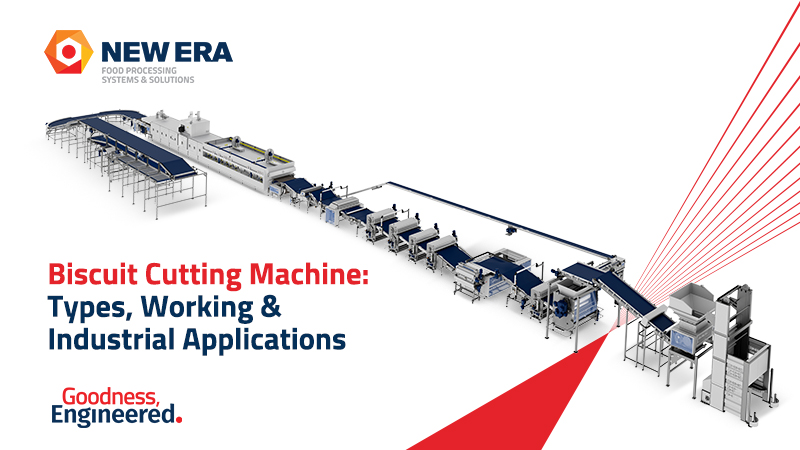
Biscuits are one of the most commonly manufactured and consumed baked items in the world, catering to the demands of the affordable tea-time biscuit and the luxury, filled and decorative bakery goods. With the increase in production quantities and quality demands, manufacturers are increasingly using precision-based automation to achieve consistency and uniformity.
The core component of this automation is the Biscuit Cutting Machine, which predetermines the ultimate shape and size as well as the appeal of each biscuit. Although the ovens and mixers may receive the biggest share of attention, it is at the cutting stage where the actual identity of the product is determined. Cutting in industrial biscuit production is not a mechanical operation but a strategic process. Efficient cutting systems decrease dough waste, stabilize the weight, and transfer it to baking, which has a direct effect on cost management and brand consistency.
Let’s discuss the types of biscuit cutting machines, their application principles, and their key industrial uses.
Understanding the Role of a Biscuit Cutting Machine in Modern Production
A Biscuit Cutting Machine is a device that works in a high-speed manner and is used to cut a uniform sheet of dough into well-shaped biscuit pieces. Also, the global biscuits market is projected to grow from approximately $127.99 billion in 2024 to $134.03 billion in 2025, showcasing uniform industry expansion as well as strong consumer demand for baked snacks. This process has to address several industrial needs at the same time:
- Dimensional accuracy and repeatability
- Minimal dough wastage
- Adaptability with different dough types
- High throughput with less downtime
In automated environments, the cutting machine does not operate in isolation. It is coordinated with upstream sheeters and downstream baking ovens as part of fully integrated biscuit manufacturing machine lines.
Large-scale factories making Marie, cream biscuits, crackers, or short-dough cookies use cutting systems that may run continuously without loss of shape fidelity or dough texture, such as those offered by New Era
Types of Cutting/Forming Systems
Trusted manufacturers of biscuit cutting machines, such as New Era, focus on complete, automated industrial processes that are specific to dough and product types. However, not all systems are labeled as plainly as a cutting machine; each line consists of high-level forming and shaping technologies.
Let’s shed light on the cutting or forming systems used in biscuit and cookie lines:
1. Rotary Cutting Technology (Hard Dough Biscuits & Crackers)
Where It Is Used:
The Hard Dough Biscuits and Crackers Production Line is where rotary cutting technology is used to roll the firm dough sheets into regular biscuit shapes with an accurate gauge roller and cutting rollers.
How It Works:
First, the dough is sheeted to a homogeneous thickness. The rotary cutter is a cylinder marked with certain wafer shapes that rolls across the dough. It also punches out the individual pieces at high speed. This type of technology is best used in products with straight edges and the same thickness because of the firmness of the dough.
Industrial Benefits:
- Extremely high throughput
- Minimal distortion of stiff dough
- Neat, sharp edges that withstand high-speed baking
This kind of cutting machine plays an essential role in lines that make popular hard biscuits such as Marie, Petit Beurre, and cream crackers.
2. Rotary Moulding Technology (Soft Dough Biscuits)
Where It Is Used:
Biscuit machine manufacturers as New Era incorporate rotary moulding machines in the Soft Dough Biscuits Production Line that mould soft dough into a specific biscuit shapes.
How It Works:
Instead of just cutting a sheet of dough, rotary moulders have engraved rollers that shape and imprint soft dough. This machine regulates the thickness, pattern, and surface detail and transfers every shaped piece onto the conveyor.
Industrial Benefits:
- Superb moulding of fine dough
- Consistent weight and pattern control
- Less damage to fragile or high-fat dough
The technique of moulding replaces conventional cutting in lines specialized in shortbread, butter cookies, and other soft dough products.
3. Wire-Cut and Deposited Cutting (Cookie Lines)
Where It Is Used:
Cookies Production Line of New Era deals with wire-cut, depositor system, and extruder-based systems applicable to a wide scope of products based on soft dough and inclusions.
How It Works:
Soft doughs and batters may be extruded and cut using high-tension wires or deposited into the preferred forms using automated depositor heads. These machines produce cookies such as chocolate chip, centre-filled, and twin coloured biscuits on the oven belt.
Industrial Benefits:
- Flexible product formats
- Handles inclusions and soft textures
- Quick recipe changeovers
This cutting method is appropriate for cookie manufacturers who need flexibility and creativity and do not want to lose their production speed.
How Biscuit Cutting Machines Work in Practice
Across industrial lines, the dough cutting or forming stage follows a structured, multi-step workflow:
Step 1: Dough Mixing
Precision mixers maintain uniform dough structure and moisture levels, a significant factor in determining cutting quality.
Step 2: Dough Feeding
Dough flow is automated between mixers and sheeters or moulders, minimizing manual operations in the process.
Step 3: Cutting or Moulding
Depending on the product line:
- Hard dough is formed by rotary cutting
- Soft dough is shaped by rotary moulding
- Wire-cut or depositor systems handle cookie batches
Every system is set to precise speed, pressure, and separation, with consistent pieces per cycle.
Step 4: Transfer to Baking
All shaped items are delivered directly to tunnel ovens or baking belts, which are part of the full production line.
Industrial Applications of Biscuit Cutting Machines
Biscuit cutting systems play a critical role across diverse industrial bakery environments. Their use extends far beyond molding dough; it has a direct effect on productivity, consistency, and the ability to scale commercially.
The following are five important industrial uses that are perfectly aligned with modern biscuit production lines like those offered by New Era.
1. Large-Scale Hard Biscuit Manufacturing Plants
Rotary cutting systems are necessary in large factories that make hard dough biscuits, such as Marie and crackers. Such systems are used on a continuous basis, operating at high speed, delivering uniform shape, thickness, and weight.
2. Premium Soft Biscuit Production Units
Soft dough biscuits must be handled with care to maintain texture and design. Rotary moulding systems are prevalent in high-quality biscuit facilities to shape complex shapes without breaking dough.
They are beneficial in higher-margin segments where appearance and surface finishing play an important role in consumer perception.
3. Industrial Cookie Production Facilities
The manufacturers of cookies depend on wire-cut and depositor-based cutting systems to work with soft and high-fat dough, containing inclusions like chocolate chips or pieces of fruit.
These systems enable manufacturers to diversify product portfolios without compromising speed, making it possible to manufacture various types of cookies on the same line.
4. Multi-Product Contract Manufacturing Facilities
Flexible cutting systems that accommodate quick changeovers are an advantage to contract manufacturers and private-label manufacturers.
This capability to shift to different biscuit formats with the minimal downtime enhances asset utilisation and minimises operational costs, particularly in plants dealing with multiple brands
5. Export-Focused and Compliance-Driven Plants
The integrated biscuit cutting systems facilitate hygiene, traceability, and consistency in facilities that supply regulated international markets. Automated cutting technology in closed production lines assists food manufacturers in ensuring high standards of food safety and quality with a high daily output.
Collectively, these applications underscore the importance of biscuit cutting systems for efficiency, scalability, and competitiveness in contemporary industrial biscuit production.
Conclusion
The Biscuit Cutting Machine is not merely a shaping tool, but a strategic tool that outlines biscuit identity, production efficiency, and profitability. Whether it is a high-speed rotary cutter to mass produce cookies or a wire-cut system to cut high-end cookies, the appropriate cutting technology helps manufacturers satisfy market demand with ease.
The demonstrations of sophisticated biscuit production lines all over the world indicate how coherent cutting systems may alter the quality of output and efficiency. New Era Machines, being a reliable manufacturer of Biscuit Machines, has remained an influential player in providing reliable, scalable, and future-based biscuit manufacturing solutions to global markets.
Looking to upgrade your biscuit production line with precision cutting solutions?
Contact now!
FAQs
1. What is the use of the Biscuit Cutting Machine?
A biscuit cutting machine is used to cut dough into uniform sizes of biscuits with high accuracy, making it efficient for industrial biscuit production.
2. What is the most suitable biscuit cutting machine for large-scale production?
Rotary biscuit cutting machines are suitable for large-scale production since they require little time and result in low dough wastage.
3. Is it possible to use one machine for various biscuit shapes?
Yes, various machines accept interchangeable cutters or dies, enabling manufacturers to make different biscuit designs on the same line.
4. What is the importance of integration with biscuit manufacturing machine lines?
Integration guarantees coordinated working, minimizes manipulation, enhances sanitation, and optimizes total production.