


When it comes to making superior biscuits in large quantities, the success of your production line begins much earlier than the oven heats up or the wrapping starts. It starts with the dough, the substance of the texture, taste, and integrity of your product. This is where the selection of the appropriate dough mixer becomes more than just a decision; it is an investment in the future of your brand. Regardless of whether you are making soft cookies, traditional hard biscuits, or creative filled biscuits, the work done at the mixer will have a direct influence on what comes out next: forming, baking, and cooling. Industrial dough mixer machines are the real workhorses of the biscuit line for any manufacturer who is targeting quality, efficiency, as well as scalability. Let’s break down how the right dough mixer improves your production line and adds consistency and high output to every batch.
Why the Dough Mixer Is the Heart of Your Production Line
All cookies begin with homogenized dough. It might sound easy, but the fact is that it is not easy to get that kind of consistency in thousands of kilograms of dough. In industrial applications, the mixer design, control system, and integration are identified:
- Even distribution of ingredients: maintaining even flavour and texture.
- Dough hydration: vital to dough elasticity and machinability.
- Repeatability of batches: ensures the standards of products over time.
- Smooth flow of process stages: minimizing downstream bottlenecks.
The rate of feeding, forming, baking, and cooling phases in an automated biscuit production line is directly determined by the output of the mixer. The lack of a well-mixed dough breaks this harmony and results in off-spec biscuits, increased wastage, and production delays. The selection of the appropriate dough mixer is therefore not about the most expensive mixer, but it is a matter of making sure that the performance of your mixer is matched to your production levels, type of dough, and quality expectations.
What Industrial Dough Mixer Machines Do in Biscuit Production
The industrial dough mixer machines are designed to do high-volume mixing with accuracy, cleanliness, and speed. To strengthen the importance of equipment such as mixers in industrial baking, according to industry reports, the global market in bakery processing equipment, including dough handling and forming machines, is expected to increase over the next few years, beginning in 2024 from USD 14.04 billion to USD 19.67 billion in 2029, meaning there will be greater investment in automation and technology to support production processes within the industry. This continuous rise in the growth pattern also reiterates the way manufacturers in the world are modernizing equipment, such as industrial dough mixer machines, due to the fact that efficiency and quality cannot be compromised in a competitive market setting. In larger lines, as those of New Era, mixers are designed strategically to cover a wide variety of dough types:
- Cookies and tender biscuits made with soft dough.
- Biscuits with high fat content, which have to be distributed.
- Thick doughs to crackers or fancy biscuits.
Horizontal Dough Mixer: The Best for Biscuit Production
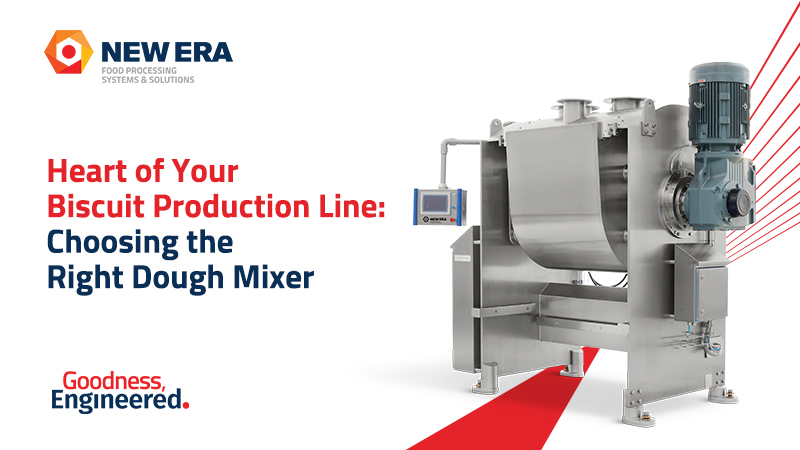
In the case of industrial biscuit lines and the consideration of dough mixers, the most applicable type of mixer is Horizontal Mixer Machines. The modern biscuit dough handling is based on horizontal mixers. These machines are designed for:
- High-volume, uniform mixing
- Regulation of dough temperature
- Tilt discharge to allow easy movement to the forming systems
- Constructed of hygienic stainless steel
The horizontal mixers from trusted suppliers like New Era are designed to provide reliable and industrial-grade functionality, including easy cleaning capabilities, ideal dispersion of ingredients, and perfect integration with feeding systems.
Customized Mixing Settings
Although most of the production requirements are met by the standard horizontal mixers, the strategy of New Era enables it to be custom-designed according to your product profile and production requirements. They may be automated discharge of dough, temperature regulation, and a combination with PLC-controllers to ensure accuracy on mass batches.
Key Factors for Choosing the Right Dough Mixer Machine
When making a decision on the correct mixer to use in your line, you must consider a number of factors:
#1 Volume and Throughput of Production
The mixer should be of the size that is meant to produce the expected volumes. Small mixers cause bottlenecks; large mixers consume more space and energy.
New Era adjusts the mixer capacity to your desired production, be it medium-scale cookie lines, rotary moulding lines, or complete biscuit production.
#2 Dough Type and Complexity
Soft doughs do not act in the same way as hard, laminated doughs of biscuits or crackers. Horizontal mixers in New Era lines are designed to operate over a wide variety of dough consistencies and assist in ensuring consistent quality of products of various types.
#3 Hygiene and Food Safety
Mixers should be able to meet the standards of the food industry. Contact surfaces made of stainless steel, with few crevices, and easy sanitation are negotiable. New Era mixer systems have been built to be easy to clean and maintain, with hygiene and operational performance, factors that are important in food safety compliance and longevity of the machine.
#4 Integration with Production Flow
The mixer belongs to a synchronized production line. Its production should be in accordance with the precise input specifications of feeding, forming, baking, and post-baking systems. Mixers in the production lines of New Era are set up to handoff to feeding systems, preventing excessive human interference and enhancing automation.
Common Mistakes to Avoid When Selecting a Dough Mixer
Most manufacturers commit mistakes that reduce efficiency in manufacturing:
- The selection of machines based on the price only
- Not taking into account capacity growth in the future
- Use of inappropriate mixers depending on the type of dough.
- Failure to integrate with feeding and forming systems.
These pitfalls can be avoided to make sure that your investment is not only able to support the needs of the present day but also the scaling opportunities of tomorrow.
Conclusion
The dough mixer machine in the complex network of the biscuit production line is not simply a utility, rather it is the heart of your whole process. The correct selection of the dough mixer will make sure that all the batches of the dough go into the line with correct consistency, temperature, and ingredient distribution to produce the best output and product. Having bespoke settings, sanitary design, and the ability to integrate with automated lines, the industrial mixer systems and production solutions provided by New Era will provide the repeatability and quality needed in the competitive bakery market today.
You can scale an established operation or roll out a new line of products; either way, collaborating with New Era will give your business the ability to achieve engineering perfection and reliable performance.
Ready to Strengthen the Heart of Your Biscuit Production Line?
Choose the apt Dough Mixer with New Era.
Contact now!
FAQs
1. What are the things I should take into consideration when deciding which industrial dough mixer machine to use?Concentrate on production capacity, dough type, hygiene needs, and smooth integration of the mixer with your production line.
2. Does New Era have the capabilities to deal with other forms of biscuit dough?Yes. The horizontal mixers of New Era are intended to work with a great variety of dough consistencies, including cookies, soft biscuits, hard biscuits, crackers, and so on.
3. What effect does the mixer have on product quality?The right mixing will guarantee uniformity in ingredient distribution, optimum dough structure and consistency, which results in improved forming, baking, and quality of the final product.
4. Does New Era offer customization to mixer systems?Yes. New Era provides customized mixer designs to meet your production needs and product specifications.