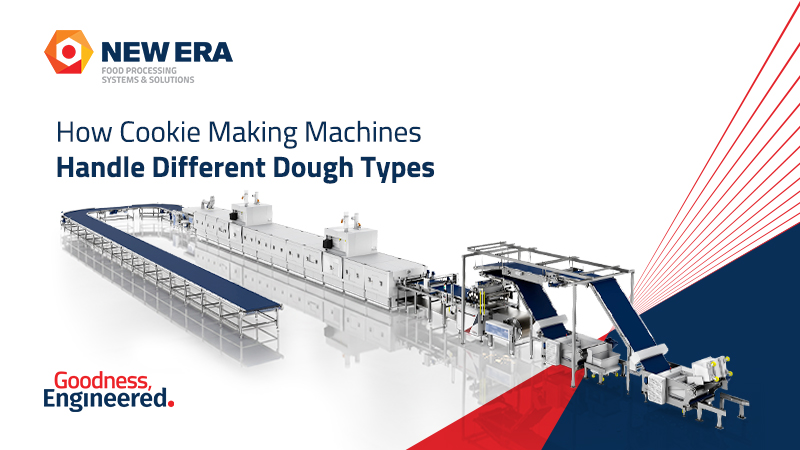
Understanding the variations in dough behaviour helps manufacturers tailor their production process, reduce waste, and achieve consistency in their products. Today, cookie production is an automated process that utilises intelligent machines that adjust automatically according to dough requirements without compromising production rate and quality.
From creating high-quality artisanal cookies to large-scale commercial production, manufacturers are turning to more sophisticated production systems capable of producing multiple cookie formulations with minimal downtime. Let’s know more about these cookie making machines.
Understanding Different Dough Types in Cookie Manufacturing
Not every cookie dough reacts the same. Reaction to mixing, depositing, forming, and baking of dough can be greatly affected by consistency, fat content, moisture content, inclusions, and gluten structure.
1. Soft Dough
Soft dough has more moisture and fat content. It is often used in chewy cookies, filled cookies, and other high-quality dessert cookies. These doughs are extremely light and require gentle handling to prevent sticking or deforming.
With non-stick surfaces, pressure control and synchronised feed, the rotary moulders and depositor systems deliver a smooth production line.
For instance, in high-volume manufacturing, some advanced automated production lines, such as those from New Era, include automatic dough feed control systems that provide accurate portion control even when dough consistency varies.
2. Hard Dough
Hard dough is firmer and more elastic and is generally used in cookies and crackers. This dough is not easy to shape, and therefore requires a stronger compression and forming power from the machines.
Hard-dough applications are typically processed using industrial sheeting and cutting systems. These systems provide thickness uniformity and reduce stresses on the dough structure, leading to even baking and less breakage.
In modern setups, all the necessary equipment for producing uniform thickness includes automated dough distribution that continuously measure and regulate pressure to account for dough resistance.
3. Wire-Cut Dough
Wire-cut cookies contain inclusions such as chocolate chips, nuts, oats, or dried fruits. These inclusions complicate the dough handling process as particles can affect forming accuracy.
Advanced wire-cut systems overcome this problem by incorporating reinforced cutting wires and applying a controlled extrusion pressure. Precision wires cut each piece of dough into a uniform size while the machine pushes the dough through nozzles.
In many high-capacity cookie plants, intelligent conveyor synchronisation systems are combined with integrated wire-cut modules to provide spacing accuracy even at high plant speeds.
4. Rotary-Moulded Dough
Patterned or embossed cookies are usually made using rotary moulding. The fat and sugar content in this dough is usually higher, and therefore it is more plastic and mouldable.
Rotary moulding systems are designed to provide consistency of design by employing engraved rollers to shape cookies. Modern cookie manufacturing facilities use flexible rotary moulding systems capable of quickly changing mould patterns for seasonal or customised product designs.
5. Deposited Dough
Deposited cookies use dough or batter-like mixtures that are very fluid. These include butter cookies and some high-quality bakery items.
Volumetric controls and programmable nozzles are used by depositors to produce uniform product weight and shape. Consistency is key, as even minor variations can impact baking spread and appearance.
Sophisticated systems from trusted providers like New Era enable manufacturers to create several deposited shapes and patterns without altering their major machine components, thus minimising downtime for production.
5 Ways to Improve Product Quality in Modern Cookie Production Lines
Quality consistency is one of the most critical factors in cookie production in the industry. These are the five ways to improve the quality of cookies in a modern cookie production line.
1. Use Automated Recipe Management
Automated recipe systems ensure accurate proportions and process parameters for each batch. This minimises the manual adjustments and inconsistencies.
2. Invest in Flexible Forming Technology
Rotary moulding and rotary cutting offer the flexibility required to process multiple dough formats with accuracy and efficiency on production lines.
3. Enhance Dough Flow Control
Automated dough feeding systems help regulate dough movement, reducing shape variations and maintaining product uniformity throughout the production cycle.
4. Synchronise Forming and Baking Operations
Linking forming speed to oven performance ensures baking uniformity in terms of texture, moisture, and colour.
5. Automate Post-Baking Handling
Cooling conveyors, stackers, and integrated packing systems help prevent damage while improving hygiene and operational efficiency.
Trusted suppliers like New Era provide effective cookie making machines to handle each dough requirement.
Importance of Automation in Cookie Manufacturing
The global demand for cookies and bakery snacks is still on the rise, with consumers craving convenience items and high-quality bakery items. Indeed, the cookies market is projected to experience a steady growth rate of 4.19% (from 2025 to 2033).
As a result of rising demand, manufacturers are increasingly investing in advanced production technologies that enable multiple types of cookies to be produced with minimal waste and high efficiency.
Automated cookie production lines not only increase productivity but also allow manufacturers to respond to consumer needs, including premium cookies, filled products, and inclusion-based formulations.
Conclusion
Cookies are a major component of modern bakery production; the ability to efficiently process different dough structures is a hallmark of successful cookie production. Modern production lines require consistency, flexibility, and accuracy at every step, from soft rotary moulded dough to hard dough biscuits and inclusion-rich cookie mix.
Today’s automated systems integrate intelligent dough handling, servo-controlled forming, advanced baking technologies, and synchronised post-baking operations to produce high-quality output for a variety of cookie applications.
How cookie making machines manufacturers, like New Era Machines, supply advanced systems to improve industrial bakery applications. At New Era, we support large-volume production of efficient and consistent bakery products, cookies and biscuits.
| Upgrade your cookie production capabilities with New Era’s sophisticated machines. Contact now! |
FAQs
1. How do cookie making machines handle soft dough?Rotary moulding systems are used to process soft dough, gently forming the high-fat dough into detailed cookie designs without compromising texture or consistency.
2. Which dough types are suitable for rotary cutting systems?Rotary cutting systems are best suited to hard dough products like crackers and low-fat cookies that require sheeting and cutting precision.
3. Can modern cookie production lines handle inclusion-based dough?Yes. Advanced automated lines for dough containing chocolate chips, nuts, oats, and other inclusions are designed to achieve a uniform product quality.
4. Why are automated cookie production lines important?Automated lines increase throughput, reduce waste, improve hygiene, enhance consistency, and enable manufacturers to manage multiple varieties efficiently.