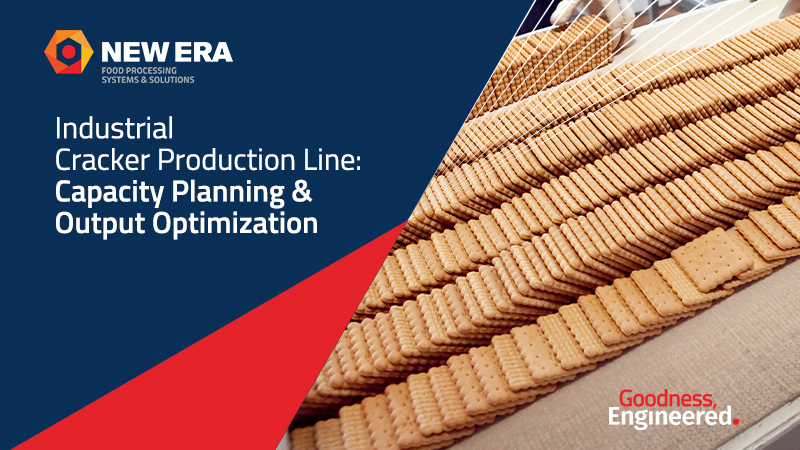
Suppose that the demand for biscuits is rising but the production facility is unable to keep pace appropriately? This can lead to a rapid decline in profits due to wasted time, fluctuating product quality, delayed shipments, and rising expenses.
In order to achieve good production results in large bakeries or FMCG facilities, it does not mean you have to acquire more powerful equipment. Achieving the desired results will take an adequate production capacity, high baking quality, and a good material flow.
Focusing on advanced technologies and studying every aspect of production helps producers establish an effective production approach.
6 Key Strategies for Capacity Planning and Output Optimization
1. Calculate Production Capacity Based on Actual Demand
The basis for planning capacity should not be just the equipment specification, but also the demand in the marketplace. Sometimes hundreds of machines operating for one hour may not be the most economical when demand is not regular, or the factory does not have the capacity to meet the full-time running needs of machines.
Manufacturers must plan:
- Forecasting: Specify the number of units needed each day, week, and month.
- Seasonal forecast: Estimate volumes expected during festive seasons, discounts, or quantity discounts for retailers.
- Production number: Estimate the number of units produced each minute.
- Growth: Prepare for future expansion without unnecessary investments.
Forecasting is essential to ensure that the production plan aligns with average and peak demand.
2. Balance Every Stage of the Production Line
A cracker production line works best when all its processes operate at compatible speeds. If the mixing, forming, baking, cooling, and packaging processes do not have the same capacity, the slower process will become a bottleneck for the entire line.
The following factors must be considered while balancing the production line:
- Capacity of mixing: Prepare the required dough batches to keep the downstream equipment functioning.
- Dough distribution: Make sure the dough continuously flows without excess accumulation or delays.
- Sheeting and laminating: Ensure that the forming process meets the dough thickness and product requirements.
- Rotary cutting: Cut dough at a constant speed with a minimum of waste.
- Oven operation: Ensure that the oven’s capacity matches the speed at which crackers enter it.
- Cooling and packaging: Prevent crackers from piling up between the oven and the packaging stage.
Correct planning of manufacturing processes helps avoid complications and ensures smooth production.
3. Choose Equipment Configurations
The type of machine is determined by the kind of cracker, the volume of production, the available space in the factory for the process, and the desired automation degree. The manufacturer of the cracker line should consider this information when making recommendations on the equipment needed.
Considerations that should be taken into account in this process include product variety, forming technology, mixing capacity, oven configuration, automation levels, factory layout, as well as future plans in terms of expansion.
For example, a production line including a horizontal mixer with recipe control and controlled dough feeding and a rotary cutting facility can assist manufacturing operations in making hard dough crackers of repeatable dimensions.
4. Optimize Baking Conditions and Energy Consumption
One can define many characteristics such as moisture level, color, crunchiness, as well as stability of the product. Despite the fact that all the upstream equipment is working properly, rejection rates may be high in case the oven conditions are unstable.
To improve baking performance:
- Adjust temperature by zones: Different heat systems must be used to create specific conditions for different products.
- Make sure that heat is distributed evenly: This minimizes differences in color and texture on the conveyor.
- Control the moisture level: It is important that the level of drying is consistent.
- Adjust the speed of the conveyor concerning the baking duration: This helps prevent underbaking.
- Save energy: Whether using fuel or electricity, record energy consumption per kilogram of product.
- Maintain equipment regularly: Burners, heating elements, temperature control systems, etc. must be checked regularly.
For example, based on the required baking profile, one can make a choice among direct gas firing, forced air, or a hybrid heater configuration.
5. Minimize Dough Waste and Enhance Material Use
The wastage of dough affects the costs of raw materials, the efficiency of workers, and the level of production waste. The dough wastage sources in the manufacturing of crackers are uneven spreading of the dough, errors in cutting, problems with dough handling, and breakdown of equipment.
Some measures to decrease waste include:
- Equal thickness of the dough: Reduce dough weight variation and improve baking quality.
- Make cutting effective: Set up rotary cutters to achieve the required product size and reduce waste.
- Use some of the dough that is reusable: Follow the recipe, the rules of food safety, and quality standards.
- Control levels of rejection: Write down defects according to their type and production stage.
- Train operators: Avoid unnecessary handling mistakes and equipment setup failures.
A production line can be achieved with accurate dough distribution equipment and rotary cutting machinery, thus reducing process variability and achieving efficient recycling.
6. Synchronize Cooling, Handling, and Packaging
The output of one oven isn’t equal to the output of the factory. The crackers need to cool off before packing and be handled carefully so as to avoid their deterioration.
The major techniques of operations improvement include:
- Ensure proper cooling time: Give the crackers enough cooling time.
- Conveyor speed balancing: Avoid stacking up between the oven, cooling conveyors, and stacking equipment.
- Minimize product transfers: Avoid unnecessary handling that can break brittle crackers.
- Coordinated packing capacity: Make sure that the packaging machines are compatible with the actual saleable output.
- Monitor the quality of the packaging: Inspect sealing and packaging requirements.
- Track losses in finished product: Keep records of reject packs, packaging stoppages, and breakage.
A production system with cooling conveyors, turntables, and stackers that use appropriate packing systems can help to ensure smoother baking to dispatch of material. Packaging capacity should also be taken into account from the beginning, not as an afterthought.
Conclusion
The optimization of capacity and output does not just depend on obtaining speedy machinery. Manufacturers have to supervise the baking procedure, minimize waste in terms of product, and maintain the same output level in the process of packaging.
A key step in this process is selecting the appropriate cracker production line manufacturer, as the equipment’s integration, process flexibility, and support can impact the production results.
New Era offers a selection of hard dough biscuit and cracker production machines that enable manufacturers to investigate production combinations that match their capacity and product needs.
Explore New Era Machines’ cracker production lines to find a solution aligned with your manufacturing goals.
FAQs
1. How do manufacturers calculate the capacity of an industrial cracker production line?
Based on the expected demand prediction, need for operating hours, loss of production equipment capacity, and packaging needs, the required output is assessed by the manufacturer.
2. Which factors influence cracker production line output?
The level of output is determined by the efficiency and consistency of the dough preparation process, as well as equipment downtime.
3. How can cracker manufacturers reduce production waste?
By maintaining uniform dough mixing, accurate cutting, proper baking methods, handling processes, and reviewing rejection levels, manufacturers can reduce waste.
4. How should a business select a cracker production line manufacturer?
Production capacity, product compatibility, automation, oven technology, maintenance requirements, and after-sales assistance are criteria that businesses need to consider.