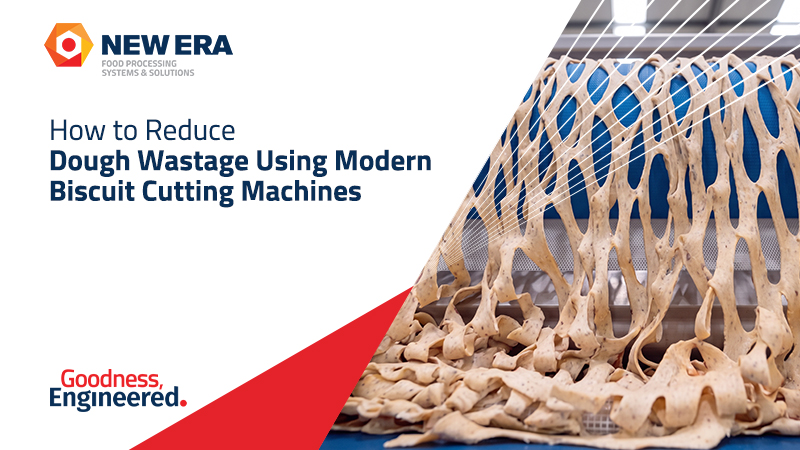
Each gram of dough is worth something. In large-scale biscuit production, even 10% wastage can cost thousands of kilograms of raw materials per month. In addition to production costs, excess dough waste impacts efficiency, sustainability, product consistency and profitability.
Most manufacturers place their attention on enhancing the mixing, baking or packaging aspects of production without giving much attention to cutting, one of the primary causes of wastage. If the cutter is not properly designed, the synchronisation is incorrect, or the machine is not up to date, the biscuit shape will be inconsistent, and there will be a lot of waste from the trims.
That’s where the modern biscuit cutting machines come into action. These machines are engineered for efficiency, intelligent synchronisation, and automatic controls to ensure that manufacturers are able to use the dough to their maximum value whilst keeping production speeds high.
This guide delves into some of the primary reasons behind dough wastage and the significance of choosing the right biscuit cutting machines to boost operational efficiency.
7 Reasons How Modern Biscuit Cutting Machines Help Reduce Dough Wastage
1. Start with Uniform Dough Mixing
Many manufacturers think that dough wastage starts in the cutting stage, but it actually starts much earlier, during mixing.
If the dough is not uniformly mixed, then variations in moisture, texture and consistency make it difficult to achieve clean and accurate biscuit shapes. A poor dough consistency can cause uneven tearing, inconsistent biscuit sizes and reject rates.
The modern production lines employ horizontal mixers that are intended to provide a dough with a uniform quality from batch to batch. This results in a stable dough structure which allows for better dough performance during sheeting and rotary cutting, thereby minimising unwanted waste.
2. Maintain Consistent Dough Feeding
If the dough is not consistently fed into the forming section, there will be dough waste even if the mixing is perfect.
Periodic breakdowns in dough flow can lead to uneven thickness in the dough, inaccuracy in cutting and production stand-stills. Overhandling can also have a negative impact on the integrity of dough and the potential for contamination.
Modern dough feeding systems are engineered to provide a steady and accurate distribution of dough during the process. The automatic dough feed control aids in maintaining a constant production rate, and integrated metal detection and automatic rejection systems eliminate contaminated dough before it reaches the cutting stage.
This cuts down on the waste of product and ensures that the raw material used is used efficiently at the manufacturing site.
3. Precision Cutting Minimises Trim Waste
The cutting section plays an important part in the efficiency of the biscuit-making process of transforming dough sheets into biscuits. Irregular biscuit impressions are common in older systems, which cause unnecessary edge trim.
Modern machines, such as those from New Era, have optimised cutter designs that enable more biscuits to be produced from each dough sheet. Minimal dough waste is achieved with better cutter alignment, resulting in consistent product size.
4. Accurate Dough Sheet Thickness Improves Cutting Efficiency
Inconsistent thickness of the dough is one of the largest contributors to production waste.
If the dough sheet is not level:
- Biscuits may not be cut through
- Dough can stick inside cutters
- Product dimensions become inconsistent
- More dough requires recycling
Today’s production lines include precision sheeting systems that work with the cutting machines to ensure that each dough sheet reaches the cutting stage at the correct thickness.
For instance, an automated hard biscuit production line typically includes synchronised gauge rolls and sheeters before the cutting section.. This results in a consistent dough sheet for clean-cutting and minimises scrap production.
5. Automation Gives Uniformity to Each Batch
Inconsistent machine adjustment is one of the main reasons for wastage in conventional production.
When a number of different biscuit varieties are produced, production variations between batches can occur because of manual changes in the machine’s settings.
Modern production equipment overcomes this with the help of automated process control and recipe management systems. The operators may save the production parameters for various types of biscuits and switch between various recipes with just a few manual parameters.
6. Consistent Baking Prevents Product Loss
Dough wastage doesn’t always occur before baking. Under- or over-baking of biscuits, as well as inconsistent colour and moisture levels, cause a considerable loss of production. The quality problems result in the rejection of batches, which causes loss of materials, as well as production costs.
Today’s biscuit manufacturing lines overcome this difficulty by incorporating baking systems that allow for precise control. Manufacturers such as New Era provide the option to select various types of ovens based on the product and production needs. This helps keep colours and moisture in check and promotes low energy use so that biscuits are produced to a consistent quality and the quantity of rejects is minimised.
7. Integrated Production Lines Improve Overall Material Utilisation
Although the cutting machine is important in reducing the wastage of dough, its performance is reliant on the integration of the machine to the other production equipment.
The production of biscuits using an efficient biscuit manufacturing process must be perfectly coordinated at every stage of the process, starting from mixing the ingredients, feeding of the dough, biscuit forming, baking, cooling and post-baking handling. If one process becomes inconsistent, it can impact the entire production line and create unnecessary waste.
Reducing Food Waste Through Efficient Manufacturing
Optimising dough use is not only a cost-saving strategy, but it’s also a sustainable food manufacturing strategy.
The United Nations Environment Programme (UNEP) Food Waste Index Report 2024 estimates that in 2022 there was around 1 billion meals per day of food wastage. The report also emphasises the need to increase the efficiency of food production and processing to minimize waste and contribute to global sustainability efforts.
Precision production equipment benefits biscuit manufacturers by minimising waste of materials and maximizing productivity, product quality and responsible use of resources.
Conclusion
Cutting is only the first and last stage in biscuit making where dough wastage can be reduced; it is essential to improve the other stages of biscuit manufacture as well. Whether it is uniform mixing of the dough, precise feeding, rotary cutting, and integration of production processes, every process helps improve the use of materials and increase production efficiency.
Modern biscuit cutting machines enable manufacturers to produce consistent, high-quality biscuits while minimising waste, lowering production costs, and maximising the value of every batch of dough.
New Era is a trusted biscuit machine manufacturer that provides state-of-the-art production solutions that integrate biscuit manufacturing technology with precision engineering. From manufacturing hard dough biscuits and crackers to cookies, New Era’s production lines are engineered to help manufacturers operate more efficiently, consistently and optimally respond to the demands of resource usage.
FAQs
1. What are the ways in which modern biscuit cutting machines help in reducing the wastage of dough?
Modern biscuit cutting machines have enhanced cutting accuracy by utilising uniformly sheeted dough, which leads to uniform biscuit shapes and minimises material loss in the manufacturing of biscuits.
2. What factors besides cutting affect dough wastage?
The efficiency of converting the dough into finished biscuits is affected by factors such as quality, dough feeding accuracy, forming accuracy, consistency in baking and product handling.
3. What are the industrial applications biscuit cutting machines?
They are commonly used to produce hard dough biscuits, crackers, cream-filled biscuits, and other commercial bakery products.
4. Why should manufacturers prefer an experienced biscuit machine manufacturer?
The whole production solution, customised equipment, technical solutions and reliable systems provided by an experienced manufacturer can be used to improve production efficiency, ensure product uniformity and minimise production waste.