
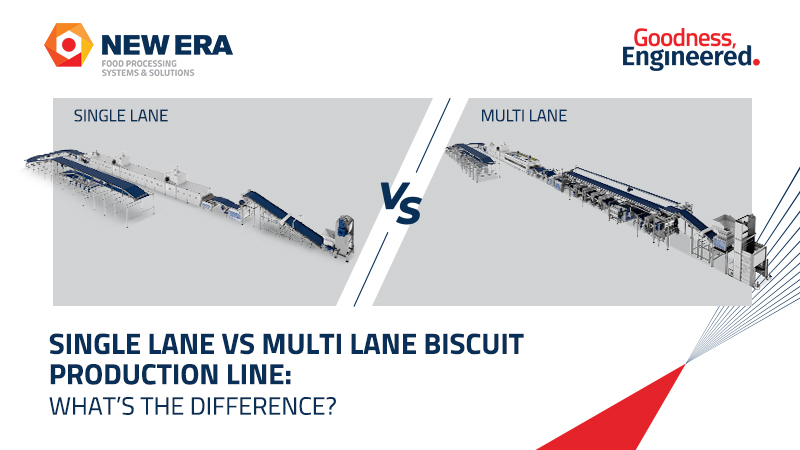
Visit any contemporary biscuit manufacturing plant, and you will see synchronisation of machines in which dough flows through a structured process: mixing, moulding, baking, cooling, and finally, packaging. However, behind this accuracy is a vital strategic decision that determines production efficiency, scalability, and profitability, whether to produce biscuits in a single lane or multiple lanes.
In the case of manufacturers, this is not merely a technical decision, but a business-defining one. Whether you are launching a niche product line or planning an expansion to meet global demand, the production line structure defines output capacity, operational flexibility, and cost-effectiveness.
To comprehend this, the blog delves into the differences between single-lane and multi-lane systems and how a trusted Biscuit Production Line manufacturer, like New Era, enables future-proof manufacturing processes.
Single Lane vs Multi-Lane Biscuit Production Line: 7 Key Differences
1. Production Capacity and Output Efficiency
The most evident distinction between a single lane and a multi-lane system is the production capacity. Biscuits are processed in one stream through a single lane biscuit production line. It is best applied in small to medium-scale production in which the output demand is moderate.
This setup is popular because of its simplicity and control with manufacturers who specialise in speciality or artisanal biscuits.
However, in comparison, a multi-lane biscuit production line uses several parallel lanes simultaneously. This tremendously enhances throughput, allowing large-scale manufacturers to produce thousands of biscuits in a minute.
For example, high-capacity lines producing cream-filled sandwich biscuits can multiply output without increasing production time through multi-lane systems.
2. Flexibility in Product Variety
Flexibility is also a key consideration in contemporary biscuit production, where consumer preferences change rapidly.
Single lane systems are highly adaptable for product changes. Switching between biscuit types, such as cookies or crackers, is relatively easier due to simpler machine layouts and fewer synchronisation requirements.
Multi-lane systems can be used on a wide variety of products, but are usually designed to produce high-volume standardised products. However, modern automated systems incorporate modular designs that allow partial flexibility, enabling manufacturers to run different SKUs across lanes with careful configuration.
This is particularly crucial in the changing biscuit-making procedure, where product innovation and customisation are important competitive advantages.
3. Plant Layout and Space Utilisation
The factory floor space is an important factor in the choice of the appropriate production line.
Single lane lines are less space-consuming and easier to install, hence suitable in startups or facilities with little infrastructure. Their linear structure makes the workflow simple and the installation process less complex.
Multi-lane lines, on the other hand, use more space because of their parallel processing units and greater equipment density. Nevertheless, they will tend to be efficient with regard to space per output in square metres, hence they can fit into the industry-scale plants.
4. Investment Cost vs Return on Investment (ROI)
Another factor that can be used in determining whether a single or multi-lane system should be implemented is the cost.
Single-lane production lines require lower initial investment. They are affordable to companies that are either new in the market or those that are niche-based. Fewer components do not demand high maintenance costs.
Multi-lane systems, on the other hand, are more capital-intensive, requiring sophisticated automation, multiple conveyors, and synchronised equipment. However, they have much higher ROI in the long term because they increase the volume of production, lessen the labour expenses, and enhance the efficiency.
An effective production line provided by reputable Biscuit Production Line manufacturers, like New Era, will guarantee that the increased initial investment will be converted to profitability in the long term.
5. Automation and Operational Complexity
Modern production of biscuits requires automation. Single lane systems have less complexity in terms of operation and management. They have fewer operators and less complex control systems, and thus they are applicable in facilities with minimal technical knowledge.
Multi-lane systems include multi-lane synchronisation. Parameters like temperature, conveyor speed, and baking time on all lanes are controlled by advanced PLC systems.
6. Quality Control and Consistency
It is important to maintain quality in the biscuit production. Single-lane systems offer strong control over individual batches, making them ideal for premium or speciality products where precision is critical.
Multi-lane systems, though, are better at providing consistency at scale. Automated monitoring systems enable manufacturers to ensure uniform texture, colour, and moisture content in thousands of cookies made at a time.
Contemporary production lines offered by New Era are equipped with real-time quality control mechanisms, which ensure all biscuits are of a high quality, irrespective of the volume of production.
7. Scalability and Future Growth
Long-term success is characterised by scalability. Single lane systems are appropriate in firms that have minimal or gradual growth prospects. Although they may be upgraded, production may be scaled by additional lines instead of increasing the size of existing ones.
Multi-lane systems are, by nature, scalable. They are suitable because manufacturers can expand capacity by adding new lanes or optimising the existing ones, which is ideal for businesses that seek to expand quickly or worldwide.
Multi-lane configurations in large production environments allow the flexibility of increasing or reducing operations without affecting the general workflow.
Why Market Growth is Driving Multi-Lane Adoption
The global demand for biscuits continues to rise, driven by urbanisation, convenience consumption, and product innovation. The biscuit manufacturing industry has been steadily growing and is expected to reach USD 217.21 billion by 2033. Key reasons for this growth also include more investments in automation and large production plants.
Multi-lane production lines are also being adopted as a new favourite as manufacturers work to fulfil this increasing demand. These systems help companies to scale effectively and still retain product consistency and minimise operational costs.
Meanwhile, single lane systems still hold significance in the niche markets, the artisanal production, and pilot-scale production, thus showing that both systems fit into the changing industry environment.
Conclusion
There is no question of choosing the better one of a single lane vs multi lane biscuit production line; it is simply a matter of matching your production strategy with your business objectives.
Single lane systems are easy, productive, and economical, hence suitable in cases of start-ups and speciality manufacturers. Multi-lane systems, conversely, provide unrivalled capacity, scalability, and efficiency to large-scale operations.
Partnering with New Era Machines, an experienced Biscuit Production Line manufacturer, ensures that your production system is not only efficient today but also adaptable for the future. At New Era, we focus on developing production lines that integrate precision engineering as well as scalable performance. We assist manufacturers to stay ahead in this competitive global market.
FAQs
1. What is the main difference between single-lane and multi-lane biscuit production lines?
Single lane systems handle one stream of biscuits, whereas multi-lane systems have parallel lanes to achieve greater output. Capacity and scalability are the primary differences.
2. What production line should small-scale biscuit manufacturers use?
Single lane production lines are more suitable due to lower investment, easier operation, and flexibility for product variation
3. Are multi-lane biscuit production lines more efficient?
Yes, multi-lane systems are much more efficient in terms of production and per-unit costs, particularly in large-scale manufacturing.
4. Is it possible to upgrade a biscuit factory from single-lane to a multi-lane?
Yes, most manufacturers start with single lane systems and then extend to multi-lane systems as demand and production increase.