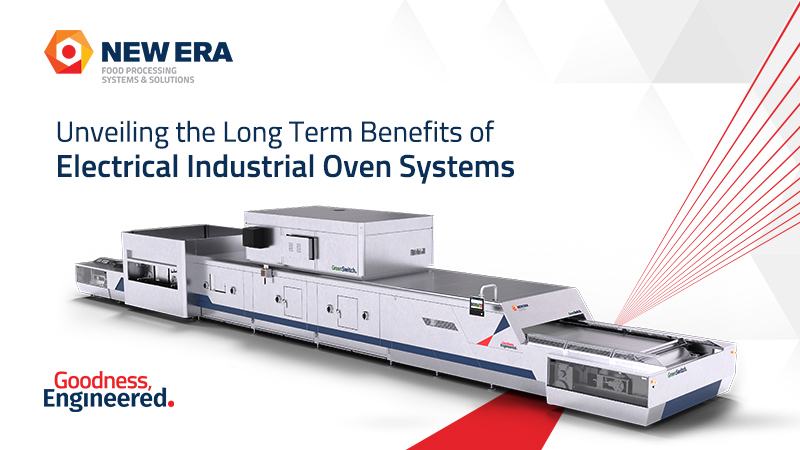
Heat has been the silent killer of industrial transformation, but in contemporary industry, it is no longer merely a matter of producing heat but rather managing it, with precision and efficiency. Electric industrial ovens symbolise this change and provide businesses with a smarter, cleaner, and more sustainable method of thermal processing.
From the big Industrial Baking Ovens to the integrated production lines, the shift to electrical systems is redefining how industries tackle the issue of efficiency, consistency, and scalability. They are not only designed to produce, but also to operate excellently over time, unlike conventional systems.
Take the example of a biscuit or bread production line in which consistency is essential. Electrically powered ovens with automated conveying systems are used in such settings to guarantee uniform baking, less wastage, and consistent quality, demonstrating how technology is beneficial for production reliability over time.
Let’s know more about the exceptional long-term benefits of electrical industrial oven systems.
5 Key Benefits of Electrical Industrial Oven Systems
1. Higher Energy Efficiency and Cost Optimisation
Energy efficiency of industrial baking ovens is one of the most powerful benefits. Electric ovens offer accurate temperature regulation, reducing heat loss and maximising energy use.
In industrial bakery environments, ovens can account for a significant share of total energy consumption, with some cases involving ovens taking most of the operating cost. Studies indicate that heating processes can represent up to 70% of energy usage in food production facilities. Electric ovens reduce wastage through better insulation, heat recovery systems, and digital controls.
In a large-scale cookie manufacturing line, e.g., substituting conventional fuel-powered ovens with electric ones may lead to uniform thermal distribution, which eliminates overbaking and energy wastage. In the long run, this will be reflected in tangible savings and better margins.
2. Accurate Temperature Regulation and Product Uniformity
Electric ovens are helping in providing a homogenous heat distribution, which is a critical factor in industrial baking ovens, where even the slightest differences may lead to a variation in the quality of the product.
New Era’s current ovens involve programmable logic controllers (PLCs) and sensors to achieve precise temperature zones. It is particularly useful in a multi-stage baking process, e.g., in the cracker or biscuit production lines, where thermal requirements vary at different stages.
Also, in wafer or biscuit production lines, electric ovens guarantee the same baking profile in batches, which minimises variations as well as decreases rejection levels. This precision directly enhances brand reliability and customer satisfaction.
3. Lower Maintenance and Operational Reliability
Electrical systems naturally possess fewer moving parts than gas or oil-based systems, resulting in lower maintenance needs and downtimes.
This ease of use also translates to long-term dependability, a critical aspect of continuous production systems. The industrial baking processes, e.g., high-volume biscuit lines, require continuous processing. Electric ovens minimise risks associated with burner failures, fuel issues, or inefficient combustion.
Such consistency in the long-term reduces maintenance costs and the overall equipment effectiveness, which simplifies the operations.
4. Improved Automation and Smart Manufacturing Integration
The electric industrial ovens are well aligned with Industry 4.0 technologies, as they can be monitored in real time, predictively maintained and optimised.
In more sophisticated production lines, like the production of cookies or snacks, electric ovens may be linked to systems that can handle temperature data and throughput. This allows operators to optimise performance dynamically.
The outcome is a highly responsive environment to manufacturing, where one can make immediate alterations to production based on the demand, reduce waste as well as maximise efficiency.
5. Scalability and Investment Value Over the Long Term
Electric industrial ovens are designed with scalability in mind. Such systems are able to be expanded or upgraded with the growth of the production requirements without significant infrastructure alterations.
As an example, new capacity additions or new zones in the oven can be incorporated in modular biscuit or bread production lines without any damage. Such flexibility allows manufacturers to scale operations with ease without disrupting the existing workflows.
In addition, the low energy costs, maintenance, and productivity increases further increase the long-term payback of the investment, thus making electrical systems a future-proof solution to industrial baking.
Why Energy Efficiency is Reshaping Industrial Baking
The movement towards electric ovens is not merely a technological phenomenon, but an economic necessity. Based on recent industry observations, up to 70 percent of electricity used in baking can be attributed to ovens because of heat loss.
This fact explains the necessity to use energy-efficient technologies. Moreover, the global market has a growing need for energy-efficient industrial ovens, and it is expected to increase the market considerably owing to its sustainability and cost-cutting requirements.
With the mounting pressure on industries to cut down emissions and operating expenses, installing new electric oven systems turns out to be a strategic move and not a technical upgrade
Conclusion
The potential benefit of the electrical industrial oven systems in the long term is that they can harmonise the efficiency of the operations with the sustainability, precision, and scalability.
These systems transform modern manufacturing as they can help reduce the use of energy, improve product consistency, etc. In large-scale production lines, be it in biscuits, bread, or snacks, integration of electric ovens not only guarantees improved output but also smarter output.
For manufacturers looking to upgrade their operations, New Era Machines serves as an example of how modern engineering and advanced design can shape the future of industrial baking.
Bring a modern touch and efficiency to your operations with New Era’s Electrical Industrial Oven Systems. Contact now!
FAQs
1. What are the key benefits of electrical industrial oven systems?
Electric ovens are energy efficient, offer precise temperature control, require minimal maintenance, and improve safety, making them suitable for baking processes.
2. What is the benefit of electrical ovens in industrial baking in terms of energy efficiency?
They limit heat loss and use advanced insulation and controls, which use less energy by an even greater degree than the use of traditional fuel-based ovens.
3. Do electrical industrial ovens work well in large-scale production?
Yes, they are highly scalable and can be integrated with automated production lines. They deliver consistent output even at high volumes.
4. What is the reason why industries are moving towards electrical industrial baking ovens?
The driving force behind the change includes cost reduction, increased efficiency, and the ability to use intelligent manufacturing systems.