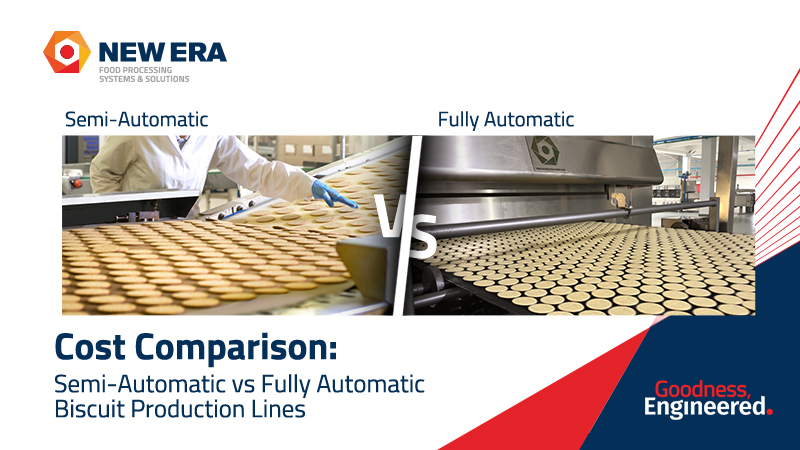
Packaged snacks, especially biscuits, are experiencing increasing consumer demand. For manufacturers entering or scaling into this market, the decision of the appropriate biscuit production line is among the most critical operational decisions. Beyond selecting machines, the debate between semi-automatic vs fully automatic biscuit production lines largely comes down to cost effectiveness, production capacity, and long-term scalability.
Although semi-automatic systems are cost-effective in initial investment, fully automated lines are more productive and efficient in operations. Knowing the real cost comparison between the two alternatives will enable bakery manufacturers to make better investments that support their growth prospects.
Let’s deep dive into the cost comparison of Semi-Automatic vs Fully Automatic biscuit production lines.
Understanding Biscuit Production Lines
A biscuit production line is a combination of a group of machinery that has been incorporated to automate various processes within biscuit production. Such stages usually involve:
- Dough mixing
- Dough sheeting or forming
- Baking
- Cooling
- Packaging
Depending on the setup and level of automation, modern industrial production lines like that of New Era’s lines have the capability of producing between 100 kg and 5000 kg of biscuits in an hour.
These steps are linked by conveyor systems and automated control panels that are used in many modern factories to maintain consistency, hygiene and efficiency. Nevertheless, the extent of automation differs greatly between semi-automatic and fully automated systems.
What Are Semi-Automatic Biscuit Production Lines?
Semi-automatic production lines are a mix of both mechanical automation and human intervention. Some of the steps are performed manually by the operators and the remaining processes are more repetitive and are performed by the machines.
Some common processes automated in semi-automatic lines include:
- Dough mixing
- Partial forming or cutting
- Baking in controlled ovens
But other activities, such as dough feeding, tray handling, or packaging, can also be manually done.
Such systems are especially popular in:
- Small bakeries
- Regional snack brands
- New entrants into the biscuit industry
Semi-automatic lines are generally capable of yielding between 50 and 200 kg/h, which is appropriate for moderate production. Semi-automatic systems in many mid-sized biscuit plants where the dough is loaded manually into forming machines, but the baking and the cooling processes are automated with automatic ovens and conveyors.
What Are Fully Automatic Biscuit Production Lines?
The fully automated production lines combine all the processes involved in the manufacture of the biscuits into a continuous process.
The fully automated line usually comprises:
- Automated dough feeding systems
- Servo-controlled forming machines
- Continuous baking ovens
- Cooling conveyors
- Combined packaging systems
Within these systems, real-time monitoring of the production process is conducted by sensors and programmed control panels. Automation provides uniformity of the biscuit size, shape, and baking quality and reduces human involvement.
Commercial large-scale biscuit production facilities are frequently equipped with Fully Automatic Biscuit Production Lines that can produce between 500 kg and more than 5000 kg of biscuits per hour, depending on the setup.
These systems best fit manufacturers who serve a national or international market where the quantity of product and a constant product quality are necessary.
Comparing the Cost of Semi-Automatic vs Fully Automatic Biscuit Production Lines
#1 Initial Investment Cost Comparison
Initial capital investment is one of the most significant differences between semi-automatic vs fully automatic biscuit production lines.
Semi-Automatic Production Line Cost
Semi-automatic cookie machines are significantly cheaper since they incorporate fewer automated parts and fewer complex controls.
Typical cost range:
- Small machines: tens of thousands of rupees
- Medium semi-automatic lines: 2 lakh to 5 lakh (approximately)
This reduced initial capital costs make them suitable for startups or small bakeries that desire to enter into production without incurring huge costs in capital investments.
Nevertheless, lower cost can frequently be accompanied by trade-offs:
- Higher labour requirements
- Lower production speed
- Increased risk of discrepancies
Fully Automatic Production Line Cost
Fully automatic lines are more expensive due to advanced technology, sensors, conveyors, and integrated control systems.
Typical cost range:
- ₹10 lakh to ₹50 lakh or more than that, depending on capacity as well as customisation.
Despite the initial high cost, these systems offer:
- Continuous production
- Reduced labour dependency
- Higher production output
- Better product consistency
For large manufacturers, the return on investment is significantly higher.
#2 Labour Cost and Operational Efficiency
Labour cost is a key factor when comparing semi-automatic vs fully automatic biscuit production lines.
Semi-Automatic Systems These lines require operators to perform tasks such as:
- Dough feeding
- Tray handling
- Product inspection
- Packaging
As a result, production depends on larger workforce.
Although the machinery is less expensive, the cost of operation rises because of:
- Salaries
- Training
- Human errors
- Production interruptions
Fully Automatic Systems
The fully automated production lines would greatly minimise reliance on labour.
A variety of large biscuit plants work with:
- 1–2 technicians for monitoring
- Sensors that automatically regulate dough flow
- Integrated rejection systems for defective biscuits
Automation reduces human error and ensures consistent product quality. Although energy and maintenance costs may be higher, the labour savings often offset the initial capital investment.
#3 Production Capacity and Output
Production capacity is one of the most decisive factors when selecting a biscuit production system.
Semi-Automatic Production Typical capacity:
- 50 kg to 200 kg per hour
It is suitable for local markets or small-scale distribution. This capacity is effective when dealing with small-scale bakeries producing specialty cookies or biscuits or short-run goods.
Nevertheless, it may be difficult to increase production through semi-automatic systems since it may need more machines and staff.
Fully Automatic Production
Large biscuit manufacturers require high production capacity.
Automated systems usually have:
- 500 kg to 5000 kg per hour production
- Continuous operation
- Integrated quality control
This renders them suitable for firms that operate supermarkets, export markets or extensive retail chains.
The biscuit production lines of New Era include automated dough dispensers that control the flow of dough and its weight to produce biscuits of the same quality in huge quantities.
Which Biscuit Production Line Should You Choose?
The decision between Semi-Automatic vs Fully Automatic Biscuit Production Lines is determined according to a number of factors.
Semi-Automatic Lines are best suited for:
- Startups and small bakeries
- Low yield capacity
- Lower initial budgets
- Local distribution markets
Fully Automatic Lines are designed to suit:
- Large-scale biscuit manufacturers
- High-volume production
- Export-oriented businesses
- Long-term operational efficiency
Practically, numerous biscuit plants start with semi-automation and switch to full automation with increased demand. Most of the biscuit production solutions provided by biscuit manufacturers such as New Era take this scalability into consideration whereby a business can start with semi-automatic lines and eventually upgrade to fully automated lines as the production demand goes up.
Conclusion
Semi-Automatic vs Fully Automatic Biscuit Production Line is a decision that largely depends on your production objectives, investment capacity, and long-term growth plan.
Semi-automatic systems provide a good entry point to smaller manufacturers, though they have production capacity and labour efficiency limitations. On the other hand, fully automated systems are more expensive to install but have high productivity, quality consistency, and long-term cost benefit.
Automation is rapidly becoming the new standard in the industry among businesses intending to produce biscuits in large quantities. It is necessary to deal with well-established Biscuit Making Machine Manufacturers like New Era so that your biscuit production can be efficient and scalable. At New Era, we are experts in the design of modern biscuit production systems that are aimed at enabling manufacturers to maximise cost and productivity.
Scale your biscuit manufacturing with the right production line? Contact now!
FAQs
1. What is the principal distinction between semi- automatic and fully automatic biscuit lines?
Semi-automatic lines require human intervention in certain stages of production, whereas fully automatic lines integrate all production processes with minimal human involvement.
2. Which is more cost-effective in the long run?
Fully automatic lines would be cost-effective in the long run since they would cut the labour costs and see more production effectiveness.
3. How much production capacity can fully-automatic biscuit lines have?
Depending on the machine configuration, industrial fully automatic biscuit production lines can produce between 500 kg and over 5000 kg of biscuits per hour.
4. Are semi-automatic biscuit machines appropriate for start-ups?
Yes. Semi-automatic machines are best suited to startups as they are relatively cost-effective to start up, and yet they enhance productivity over manual production.