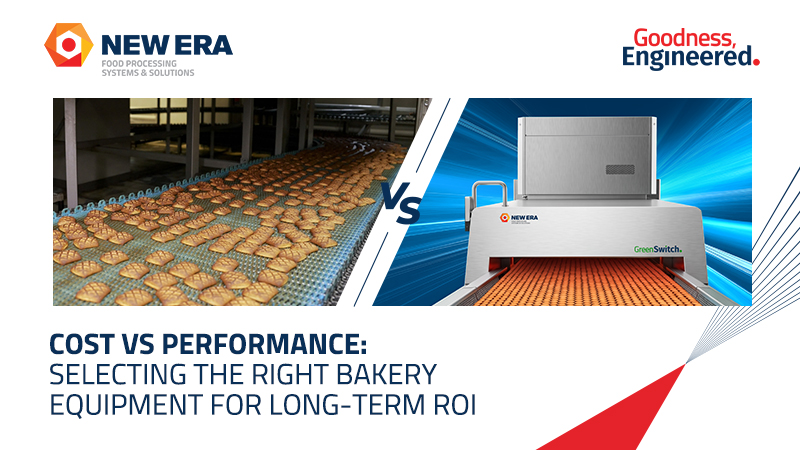
One of the most important investments any bakery business will make is bakery equipment. While it may seem that price is the most important factor, experienced manufacturers know that the real value lies in long-term performance and reliability.
A machine that costs less often fails or gives a shorter production run may actually cost more than a higher-cost, reliable machine. Whether you’re launching a new bakery or expanding an existing production facility, choosing bakery equipment for long-term ROI requires a strategic approach.
This guide is a practical checklist that bakery machinery buyers should know before making the purchasing decision.
How to Select Bakery Equipment That Delivers Long-Term ROI
1. Look Beyond the Initial Purchase Price
The purchase price is just one element of the investment. The true cost of ownership includes installation, energy costs, maintenance, downtime, etc.
So, evaluate:
- Total Cost of Ownership (TCO)
- Expected machine lifespan
- Annual maintenance expenses
- Production efficiency
- Product wastage levels
Machines that operate reliably for 10-20 years or more may yield much greater returns than low-cost alternatives.
2. Production Efficiency Directly Impacts ROI
The more efficient the production, the more products are produced using the same resources.
Modern bakery production lines reduce:
- Manual handling
- Product inconsistencies
- Ingredient wastage
- Production bottlenecks
- Labour dependency
For example, an integrated biscuit manufacturing line with automatic dough preparation, rotary moulding, baking, cooling, and packaging, such as production lines offered by New Era, can significantly enhance productivity over semi-automatic manufacturing.
Many long-term production line supplier companies showcase how coordinated automation can improve production rates and ensure product quality throughout the manufacturing process.
3. Energy Efficiency Saves Money Every Single Day
One of the biggest recurring expenses in industrial bakeries is energy.
Modern bakery equipment for long-term ROI often includes:
- Efficient burner systems
- Improved insulation
- Variable frequency drives
- Intelligent temperature controls
- Heat recovery technologies
For high-volume manufacturers, 10–15% energy efficiency gains can result in significant annual savings.
When comparing suppliers, ask for:
- Power consumption reports
- Fuel efficiency data
- Operating cost estimates
- Real production benchmarks
These numbers give a better indication of the cost of operating over the long term.
4. Consistent Product Quality Protects Your Brand
Customers expect every biscuit, cookie, or cracker to look and taste identical.
Equipment with precise automation ensures:
- Uniform dough thickness
- Accurate moulding
- Even baking
- Controlled cooling
- Consistent moisture levels
Safety issues and inconsistent product quality can result from poor equipment, leading to customer grievances and rejections.
For instance, advanced hard biscuit and cracker manufacturing systems rely on automated process controls to ensure uniformity in high-volume production and help to reduce waste and preserve the brand’s reputation.
5. Scalability Matters More Than Most Buyers Realise
Many bakeries outgrow their first production line within a few years.
Rather than buying a full-scale system, scalable equipment enables businesses to add:
- Additional ovens
- Extra cooling conveyors
- Higher-capacity mixers
- Automated packaging
- Digital monitoring systems
Adopting modular equipment allows production to expand without large changes to the factory.
This flexibility has a positive effect on the long-term return on investment, as the growth to be expected in the future will be achieved without high capital investment.
6. Maintenance Should Be Simple, Fast, and Affordable
Unexpected downtime directly affects profitability.
When buying machinery, consider:
- Spare parts availability
- Maintenance schedules
- Technical documentation
- Remote support capabilities
- Local service engineers
Machines with standardised components and easy-access maintenance points reduce servicing time considerably.
Leading production line manufacturers, such as New Era, design equipment specifically for simplified maintenance, which enables the operator to carry out maintenance operations on the machine with minimal production interruptions.
7. Automation Saves Labor Expenses
Labour shortages continue to affect food manufacturing worldwide.
Automation offers measurable benefits:
- Reduced operator dependency
- Faster production
- Lower human error
- Improved hygiene
- Better production planning
Although automated systems require higher initial investment, labour savings often recover those costs within a few years.
Automation is becoming a competitive necessity rather than a luxury for growing bakeries.
Bakery Equipment Manufacturers in India vs Global Suppliers
The decision of bakery equipment manufacturers in India or overseas suppliers is based on considering different factors; let’s have a look.
| Factor | Bakery Equipment Manufacturers in India | Global Suppliers |
| Initial Investment | Generally more competitive | Higher upfront investment |
| Customisation | Better suited to regional requirements | Standardised configurations |
| Spare Parts Availability | Faster local availability | Often requires international shipping |
| Lead Time | Usually shorter | Often longer due to overseas logistics |
| Technical Support | Local service teams | Global support networks |
| ROI | High for domestic manufacturers | Strong for multinational production facilities |
| Compliance | Suitable for Indian manufacturing standards | Strong international certifications |
The decision should be based on the business goals and not just price comparison.
Today, many bakery machine manufacturers in India are able to provide state-of-the-art automation, energy-efficient systems, and international standard engineering that can compete with the world’s best equipment manufacturers.
Checklist: Bakery Machinery Buyers Should Never Ignore
Before investing, it is important that every bakery owner consider this useful checklist.
- Production Capacity: Ensure machinery meets current demand and growth for the next 5-10 years.
- Automation Level: Identify which is a better solution, semi-automatic or fully automatic systems, based on labour availability and production goals.
- Energy Consumption: Compare electricity and fuel costs on an annual basis, not just on a purchase basis.
- Product Flexibility: Select equipment that can be used to make several products and has little changeover time.
- Food Safety Standards: Check compliance with food-grade materials and hygienic design guidelines.
- Service Support: Evaluate response time, spare part availability and preventative maintenance services.
- Future Expansion: Use modular equipment that can be upgraded rather than replaced.
Why Production Line Integration Leads to Better Returns in the Long-Run
Many manufacturers purchase machines individually over several years. While this will help in cutting down on the first investment, it can lead to compatibility problems with various equipment.
Some of the benefits of an integrated production line include:
- Smooth product flow
- Better synchronisation
- Reduced downtime
- Easier quality control
- Centralised automation
- Lower maintenance complexity
This type of integration generally provides better long-term ROI than when you use a mix of different vendors. Also, the global trend of the food processing industry is to shift from stand-alone machines to integrated production lines. The global food processing automation market is projected to grow at 7.49% CAGR till 2030.
Manufacturers are choosing to invest more into integrated systems, which are becoming more effective in coordinating mixing, forming, baking, cooling and packaging operations to increase productivity whilst reducing downtime.
Conclusion
Making bakery equipment investments worthwhile in the long run is dependent on balancing the costs and benefits. Over the long term, the cheapest piece of equipment is not necessarily cost-effective, and the most carefully designed equipment can yield substantial savings in productivity and reduced downtime.
While evaluating bakery machine manufacturers in India or suppliers abroad, it is important to take into account the total ownership expense rather than the cost of the bakery machine.
New Era, your trusted biscuit machine manufacturer, proves that automated bakery production line solutions enable manufacturers to deliver consistent performance and sustainable growth in a variety of bakery applications.
| Want to get the maximum long-term return from your bakery? |
FAQs
- Why is it important to automate bakery equipment for long-term ROI?
Automation means less reliance on labour, more consistency in production, less wastage of products and more output – contributing to better long-term profitability.
- What should be included in a bakery machinery buying checklist?
All production capacity, scalability, energy efficiency, automation level, food safety compliance, maintenance requirements, spare parts availability and after-sales support should be included in a complete checklist.
- How do bakery equipment manufacturers in India compare with global suppliers?
Modern manufacturers in India can offer more sophisticated automation, better pricing, and excellent service support in the area, while overseas manufacturers offer more extensive international certification and technology.