
Are you facing increasing pressure about scaling biscuit production without compromising the quality? With the structural change in the global bakery industry in progress, and the growing need of consumers for packaged, hygienic, and uniform bakery products, the pressure is truly increasing on the commercial bakeries. Cookies are at the centre of this revolution as they are one of the most consumed baked goods globally.
Manual and semi-automatic procedures that used to be adequate for small-scale operations are no longer effective with large-scale operations. This is where an Automatic Cookies Production Line is not only just an upgrade, but a strategic requirement. Automated cookie lines are designed to combine several processes, such as mixing, forming, and baking, into a coordinated process to enable bakeries to work at an industrial scale with precision.
In the case of bakeries that intend to expand or modernize, it is of paramount importance to choose the appropriate cookie production line manufacturer. Let’s see what the automatic cookies production line has in store for you.
Understanding Automatic Cookies Production Line
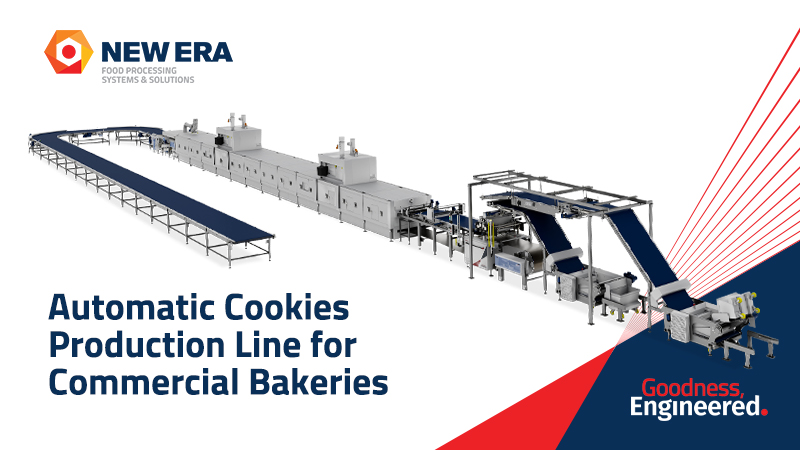
The automatic cookies production line is a complete and automated system designed to transform raw materials into finished cookies through an automated process. In contrast to the fragmented machinery arrangements, a production line is a unified system with one stage supplementing another.
Modern commercial bakeries usually contain the following lines:
- Dough preparation and feeding systems
- Forming or depositing mechanisms
- Baking ovens with regulated temperature zones
- Conveyors to maintain structural stability
- Transfer systems for downstream handling
The industrial bakery arrangements are usually based on a modular production line, which can process a broad range of cookie formats, either wire-cut, deposited, or extruded. These systems enable the seamless movement of cookies of various types without affecting the production flo
An example of such engineered solutions is the multi-purpose Cookies Production Line of New Era. Their systems are constructed to handle wire-cut cookies, jam-centred or co-extruded bars, with precise dough feeding and hygienic stainless steel.
Why Automation Matters Now
The cookies market in the world is still strong and expanding, hence automated production systems are becoming more important. The global cookies market size is estimated at USD 42.31 billion in 2025, and it is expected to improve over the second half of the decade, according to industry analysis, demonstrating high levels of demand for convenience snacks among consumers on an international level.
These expansion drivers support the reason why commercial bakeries are investing in automation: they must be able to scale production in an efficient manner, manage food safety risks, and preserve product quality as market competition increases.
Key Components That Drive Production Efficiency
1. Dough Feeding and Dough Handling Systems
High-quality cookies depend on the dough consistency. Automation also guarantees a consistent flow of dough into the forming machines, eliminating human mistakes and material wastage.
Precision in the dough handling has a direct effect on the product texture and the weight accuracy.
2. Cookie Forming and Shaping
Wire-cut, depositor-based, and extruder-based biscuit-forming processes are usually supported by automatic cookie production lines. These systems provide high rates of uniform cookie production while preserving shape.
Many commercial processes depend on fully installed forming systems capable of accommodating various types of dough without affecting the cycle times
3. Industrial Baking Ovens
The most important part of cookie production is baking. Multizone automated tunnel ovens have precise heat distribution, which eliminates uneven color, texture, and moisture. Large-capacity industrial ovens allow bakeries to operate continuous production without batch interruptions.
4. Cooling and Conveying Systems
Cookies should be allowed to cool after baking to maintain their structure and avoid fractures. Cooling conveyors are automated to progressively lower product temperature, enabling cookies to be handled, inspected, or packaged.
These conveyors are designed to match the baking output to avoid production bottlenecks.
Why Commercial Bakeries Are Shifting to Automation
#1 Scalability and Flexibility
Scalability is one of the most feasible benefits of automated cookie lines. Commercial bakeries usually have a certain capacity requirement, which increases with market demand.
Well-designed production lines enable:
- Upgrades without complete system replacement
- Integration of additional modules
- Easy flow between various cookie formats
Such flexibility is a pillar of industrial systems operating in large-volume factories where flexibility and time to produce products are of paramount importance.
#2 Production Consistency
Automation removes variation through manual handling. The products made in an Automatic Cookies Production Line follow the same parameters, and cookies across batches are similar in size, texture, and taste.
#3 Quality Control
Automation does not replace quality control, it enhances it. Deviations are easier to detect due to consistent process parameters that ensure products meet set quality standards.
In-line inspection points and synchronized feedback loops can be configured in industrial lines to identify problems before large quantities are produced.
#4 Increased Throughput and Reduced Labor Reliance
Automated lines can contribute to a higher production rate with less dependence on skilled workers to perform repetitive work. This enables the bakeries to allocate human resources to areas like quality control, maintenance, and operational improvements.
#5 Increased Food Safety and Hygiene
Current cookie manufacturing lines are built using food-grade materials and easy-to-clean designs. Limited human interaction prevents the contamination risks and helps bakeries meet high food safety standards.
#6 Operational Optimization and Energy Efficiency
Modern cookie lines are becoming more energy efficient. Constant bakery ovens, synchronized conveyor belts, and smart control displays lead to lower overall power usage.
Bakeries that implement energy-optimized automation tend to notice:
- Lower operating expenses
- Shorter cycle times
- Reduced idle energy loss
- Improved uptime
Such operational efficiencies support return on investment and sustainability objectives.
#7 Cost Optimization Over Time
Even though automation may have initial investment costs, the long-term benefits of reduced wastage, lowered energy consumption, and increased throughput result in significant savings over production cycles.
Conclusion
Automatic Cookies Production Line is no longer an option for commercial bakeries, but it is the strategic investment that can achieve efficiency, uniformity, and scalability. Integrated production lines reduce the number of production steps while maintaining product quality.
Selecting the correct cookies production line manufacturer guarantees that the bakeries receive scalable and reliable solutions for their production requirements. With New Era Machines, you can get the proven technology and extended support to meet modern production and future growth demands.
New Era is your trusted automation partner with decades of experience in industrial bakery systems. Contact us now!
FAQs
1. What is an Automatic Cookies Production Line?
It is a complete system that automates the dough handling, forming, baking, and cooling to make cookies at a large scale with uniform quality.
2. Would an automatic cookie line fit well in a medium-sized bakery?
Yes, the modern production lines are modular and scalable, and thus, they are applicable to medium and large-scale commercial bakery operations.
3. What are the benefits of automation in improving cookie quality?
Automation ensures consistent process control, resulting in uniform shape, texture, and baking quality.
4. What do bakeries need in a Cookies Production Line manufacturer?
Bakeries should focus on manufacturers with industry experience, customization capabilities, reliability, and adherence to food safety standards.